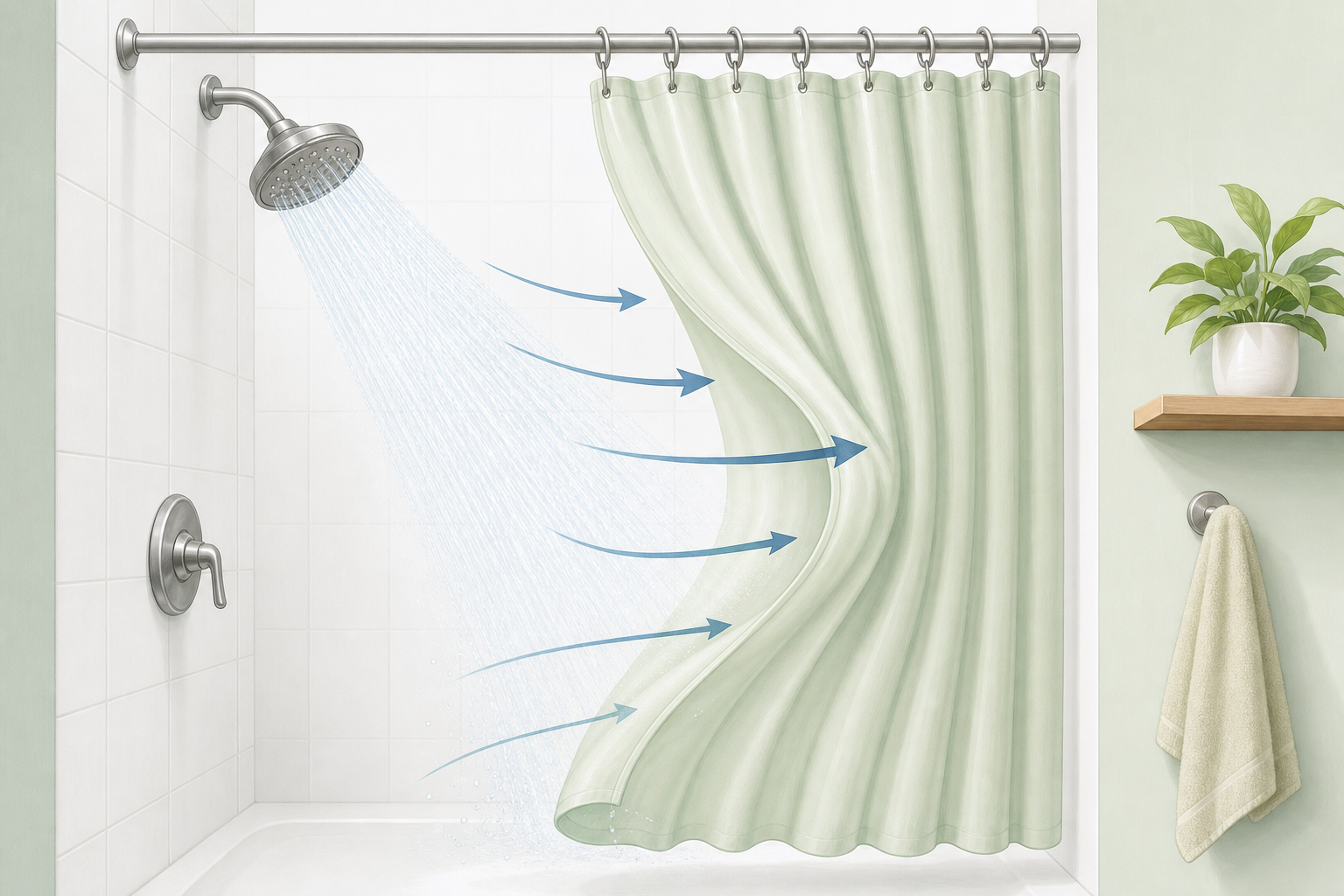
Have you ever wondered why your shower curtain seems to move toward you while showering? This curious phenomenon can be primarily attributed to pressure differences created by the flow of water. As the water cascades down from the showerhead, it reduces the nearby air pressure, pulling the curtain inward. This article delves into the fascinating science of fluid dynamics that underpins this everyday occurrence.
The inward movement of your shower curtain is predominantly caused by a pressure difference stemming from falling water. As water flows, it creates lower air pressure around the curtain, drawing it closer.
The Short Answer
The inward movement of your shower curtain is predominantly caused by a pressure difference stemming from falling water. As water flows, it creates lower air pressure around the curtain, drawing it closer.

Original AI-generated educational image for Why Science Daily.
The Science Behind It
When you turn on the shower, warm water streams down, initiating a series of interactions within the bathroom. This stream creates a localized drop in air pressure around the curtain, a concept defined by Bernoulli's principle. It states that as the velocity of a fluid increases, its pressure decreases. The swift descent of water leads to reduced air pressure near the shower curtain.
Simultaneously, the curtain's position in relation to the airflow plays a vital role. The movement of water creates vortices, mini whirlpools of air that change the dynamics of air pressure. As the air flows around the curtain, these vortices contribute to a greater pressure differential, with higher pressure air outside the curtain pushing inward while lower pressure air pulls it toward you.
This effect is magnified in an enclosed space, such as a bathroom without proper ventilation. In these conditions, the pressure differences increase, allowing lightweight and flexible curtains to react dramatically to unseen forces. Thus, the combination of air pressure interactions and water dynamics transforms what seems like a whimsical incidence into a scientific reality every time you take a shower.
In essence, the shower curtain's movement beautifully illustrates fundamental principles of physics in action. Understanding these underlying mechanisms elevates what is often taken for granted into a source of inquiry and wonder about the physics governing our daily experiences.
An effective way to grasp this concept involves referring back to the specific mechanics at play. The phenomenon is intricate, reliant on how air pressure, water flow, and Bernoulli’s principle intertwine under standard shower conditions. This depth of understanding prevents oversimplifying the explanation and allows for a richer grasp of the scenario.
It's also worth discussing the scale and nuances involved with the shower curtain interaction. The forces responsible for the curtain's behavior are often subtle and gradual, not immediately perceptible to the naked eye. Understanding this phenomenon benefits from distinguishing visible phenomena from the underlying physics that govern these everyday experiences. Each interaction is a small component of a broader set of forces acting concurrently, leading to the final observable effect.
Additionally, the design and material of the curtain itself matter significantly. The characteristics of the curtain—its shape, weight, and textile—are crucial in determining how it interacts with airflow dynamics. Often viewed as a single entity, the behavior of the curtain is contingent upon a variety of physical factors, from load distribution to pressure gradients that arise in the confined bathroom space. These subtleties can frequently be overlooked, yet they profoundly impact how the curtain behaves during your shower.
Drawing parallels, similar principles of fluid dynamics can be observed in different contexts. For instance, the movement of a boat through water similarly relies on pressure differences. Likewise, hot air balloons rise based on how pressure variances affect their structure and the surrounding air. The dynamics of your shower curtain thus serve as an accessible entry point into comprehending broader fluid mechanics observed throughout nature.
Recognizing these scientific principles encourages us to inquire about the underlying causes of similar phenomena we encounter. Whether it’s during outdoor activities or even while inside our vehicles, an understanding of fluid dynamics fosters not only scientific literacy but also a greater appreciation for our environment.
Ultimately, one key takeaway from considering the shower curtain's behavior is that everyday observations rarely stem from a singular cause; instead, they result from a convergence of multiple interacting conditions. By acknowledging and exploring these specifics, we unlock opportunities for deeper inquiry and a stronger connection to the physical world around us.

Original AI-generated educational image for Why Science Daily.
The Common Misconception
A prevalent misconception is that drafts caused by external air—such as wind from open windows—are the primary reason the shower curtain moves toward you. While these drafts can influence air movement, the crux of the curtain's motion lies in the pressure disparity created by the water flow.
Another frequent misunderstanding is that heavier shower curtains would be less susceptible to this inward movement. In fact, lightweight and flexible materials are easier to pull inward due to the difference in surrounding air pressure, rendering thicker or heavier curtains more resistant but less responsive to rapid changes in airflow conditions.
Some also believe that closing the bathroom door would eliminate this effect. While doing so reduces airflow from outside, it does not account for the pressure changes fostered by water flow. Even within a closed space, pressure differentials will still emerge, enabling the curtain to move.
Others speculate about temperature levels playing a vital role in curtain behavior. While hot water can increase humidity and marginally influence airflow patterns, it does not fundamentally alter the primary mechanism at work – the pressure difference resulting from the water's descent. Understanding these misconceptions sheds light on the scientific principles affecting our bathroom dynamics.
By elevating our awareness of these principles, we empower ourselves to grasp our surroundings more fully while nurturing an inquisitive mindset towards everyday phenomena. Each encounter presents a chance to delve deeper into understanding the physics that underpin our experiences.

Original AI-generated educational image for Why Science Daily.
A Real-World Example
Picture yourself stepping into the shower, and as the hot water starts to fall, you notice that your lightweight vinyl shower curtain begins to sway inward. This can often feel disruptive, leading to a common question: why does it behave this way?
An illustrative example can be drawn from contemporary shower designs. Some utilize weighted bottoms or magnetic strips to counteract this inward movement. Nevertheless, if the water flow is vigorous, even these measures often fail to stop the tugging effect on lighter curtains.
Consider another scenario where weather patterns influence household dynamics. During a rainstorm, if you leave your windows ajar, you may observe curtains in your living room blowing into the room as air pressure fluctuates. This response to air pressure changes mirrors the reaction seen with the shower curtain, affirming that fluid dynamics applies broadly across various contexts.
You can also observe this principle by fanning a sheet of paper. Creating a swift airflow above the paper results in lower pressure underneath, causing it to lift. This small-scale demonstration illustrates similar air pressure dynamics involved in the shower scenario.
In colder months, you may observe how lighter curtains flutter towards heating vents. This subtle internal movement is yet another example of how fluid dynamics extends beyond water to include air currents and their effects on common household objects. Such observations become valuable lessons, allowing us to appreciate the ubiquitous nature of fluid dynamics in our everyday lives.
Final Takeaway
The captivating movement of your shower curtain is rooted in the principles of fluid dynamics and pressure differences. It highlights the intriguing interplay between water flow and air pressure, transforming an ordinary moment into a profound lesson in physics by illustrating scientific concepts in action.
Quick Comparison
| Part | Focus | What to remember |
|---|---|---|
| Main idea | shower curtain | When you turn on the shower, warm water streams down, initiating a series of interactions within the bathroom. This stream creates a localiz… |
| Common mistake | Misconception | A prevalent misconception is that drafts caused by external air—such as wind from open windows—are the primary reason the shower curtain mov… |
| Everyday takeaway | Practical meaning | The captivating movement of your shower curtain is rooted in the principles of fluid dynamics and pressure differences. It highlights the in… |
FAQ
Why does the shower curtain stick to me while I shower?
The shower curtain moves toward you due to a pressure difference created by the falling water. Water flowing down creates lower air pressure around the curtain, causing it to be drawn in.
Can a heavier curtain prevent this effect?
Heavier curtains may appear more stable, yet their added weight can make them less responsive to air pressure changes. Lightweight curtains generally react more noticeably to airflow.
Does closing the bathroom door stop the curtain from moving?
Closing the door may mitigate some external airflow, but the curtain's movement is driven primarily by pressure differences induced by water flow, which persists regardless.
How does Bernoulli's principle relate to the shower curtain?
Bernoulli's principle posits that as a fluid's speed increases, its pressure decreases. This principle is crucial in understanding why a shower curtain is pulled inward during water flow.
Are there ways to control shower curtain movement?
Magnetic strips, weights, or suction cups can reduce curtain movement, though they can't entirely negate the effects of pressure changes caused by water flow.
Sources and Further Reading
- 12.2 Bernoulli’s Equation – College Physics | OpenStax
- 4.5.3: Bernoulli’s Principle – Chemistry LibreTexts
- 1.3.5: Bernoulli’s Equation – Physics LibreTexts
- Arggh, Why Does the Shower Curtain Attack Me? | TPR
- FLUID MECHANICS
Originality notice: This article is published by Why Science Daily. Please cite and link to the original page when referencing this content.
Keywords: shower curtain, air pressure, vortices, bernoulli, water flow, fluid dynamics, pressure difference, bathroom physics