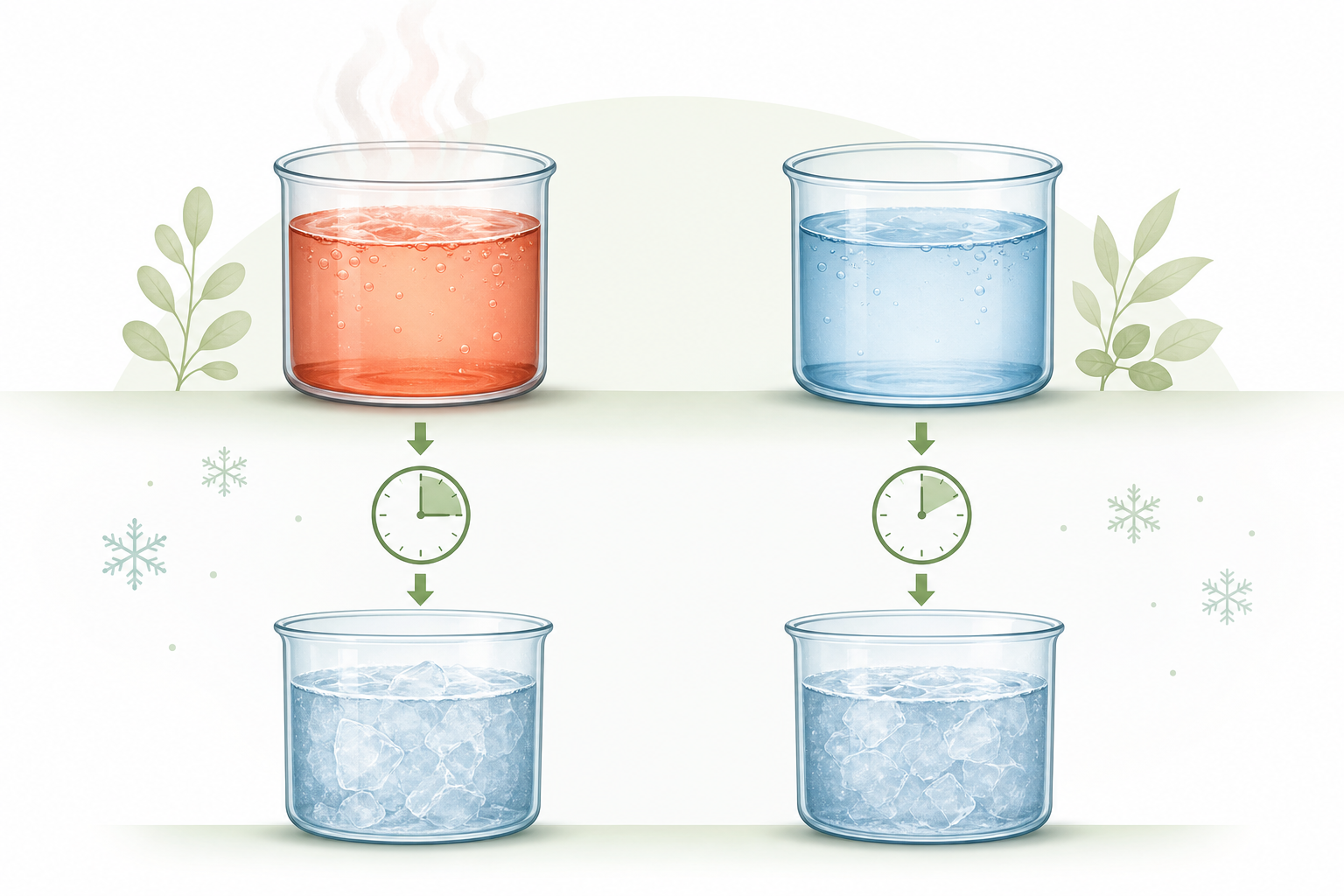
The Mpemba Effect presents a striking phenomenon: under certain circumstances, hot water can freeze faster than cold water. This paradox has captured the curiosity of scientists and enthusiasts alike, driving an investigation into the underlying mechanisms causing this seemingly counterintuitive behavior. Understanding the dynamics of evaporation, convection, and temperature differences allows us to explore how these factors play a pivotal role in the freezing process.
The Mpemba Effect indicates that hot water may freeze faster than cold water due to mechanisms such as evaporation, enhanced convection currents, and density variations, all influencing the rate of heat loss.
The Short Answer
The Mpemba Effect indicates that hot water may freeze faster than cold water due to mechanisms such as evaporation, enhanced convection currents, and density variations, all influencing the rate of heat loss.

Original AI-generated educational image for Why Science Daily.
The Science Behind It
The term 'Mpemba Effect' originates from Tanzanian student Erasto Mpemba, who observed this curious behavior in the 1960s. Several mechanisms contribute to this effect, primarily focusing on evaporation. When hot water is exposed to air, a significant amount can evaporate, thereby decreasing the volume that needs to freeze. This evaporation not only lessens the mass of water but also allows the remaining water to cool more efficiently, as the loss of water translates to a faster approach to freezing temperatures.
Moreover, convection plays a critical role in this phenomenon. In hot water, convection currents develop as warmer water rises and cooler water sinks. This movement leads to a more uniform temperature distribution within the liquid, aiding in the rapid dissipation of heat. In contrast, cold water may experience less movement, which could slow down the freezing process.
Density differences are equally important. Hot water is generally less dense than cold water, which means that the way heat is expelled during freezing could be different. Early in the freezing process, the less dense regions in the hot water might form ice more readily compared to their colder counterparts, facilitating a quick transition to solid ice.
It’s crucial to note that the Mpemba Effect is highly conditional. Factors including air temperature, humidity, and even wind speed can significantly influence the freezing rates of hot versus cold water. The type of container used, as well as the water’s purity, also contribute to the extent of the effect. Utilizing materials that conduct heat efficiently can amplify the differences in freezing behavior, further complicating the phenomena involved.
Exploring the Mpemba Effect reveals the intricate nature of thermodynamics. While it might defy intuition at first glance, the interaction of evaporation, convection, and density highlights the nuanced interplay of temperature and phase changes in matter. This complexity emphasizes the beauty of thermodynamic studies, as they unravel the principles underlying everyday observations.
To assess the validity of the Mpemba Effect, one can compare the apparent results with its underlying principles. A practical experiment could involve freezing two containers of water, one hot and one cold, while carefully monitoring their conditions. This method reinforces that science isn't merely about surface level observations; it digs into the conditions that lead to visible outcomes. The significance lies in recognizing that many factors contribute collectively rather than attributing the phenomenon to a single cause.
Another crucial point is comprehension of scale. Often, the important details are small or gradual, making them easy to overlook. By examining the interactions and motions at play, science clarifies how big influences can create the observed pattern, leading to more reliable explanations rather than simplistic conclusions.

Original AI-generated educational image for Why Science Daily.
The Common Misconception
A prevalent misconception regarding the Mpemba Effect is the assumption that hot water will invariably freeze more swiftly than cold water. In reality, this effect is determined by a myriad of situational factors. For instance, if hot water is subjected to very cold still air, it may fail to exhibit the Mpemba Effect, thereby causing cold water to freeze at a quicker rate due to reduced evaporation effects.
Another misunderstanding is the notion that all hot water automatically freezes faster than all cold water. Aspects such as initial temperature, water volume, and container material significantly influence freezing times. Therefore, while the Mpemba Effect sheds light on certain thermodynamic principles, it doesn’t have universal applicability in freezing scenarios.
Inconsistent reproducibility of the Mpemba Effect in controlled experiments further illustrates the complexities of the underlying thermodynamic principles at play. Ongoing research is essential for achieving a clearer and more comprehensive understanding of this phenomenon. Such intricacies remind us that nature doesn’t always align with expectations, underscoring the importance of scientific investigation to clarify observable occurrences.

Original AI-generated educational image for Why Science Daily.
A Real-World Example
Consider an occasion where two identical containers filled with water—one hot and another cold—are placed outdoors on a frigid day. Depending on the surrounding conditions, such as wind or insulation, the hot water may begin to freeze faster than the cold, providing a real-world glimpse into the Mpemba Effect.
In culinary applications, boiling water for cooking can illustrate this principle. Chefs may observe that when hot water is introduced into a cold environment, it appears to cool more rapidly than cold water that has been chilled previously. However, this observation hinges heavily on environmental variables and demands careful observation.
Another relatable scenario involves the use of a hot water bottle. When left in a cold room, the warmer bottle often loses heat faster than a cooler one under optimal conditions. These examples not only ground the Mpemba Effect in everyday experiences but also highlight engaging scientific principles at work in our daily lives.
Final Takeaway
The Mpemba Effect enriches our understanding of thermodynamics by demonstrating that hot water can freeze faster than cold under specific conditions. Delving into mechanisms like evaporation, convection, and density differences enhances our grasp of freezing processes and temperature dynamics in the physical world.
Quick Comparison
| Part | Focus | What to remember |
|---|---|---|
| Main idea | hot water freezing | The term 'Mpemba Effect' originates from Tanzanian student Erasto Mpemba, who observed this curious behavior in the 1960s. Several mechanism… |
| Common mistake | Misconception | A prevalent misconception regarding the Mpemba Effect is the assumption that hot water will invariably freeze more swiftly than cold water…. |
| Everyday takeaway | Practical meaning | The Mpemba Effect enriches our understanding of thermodynamics by demonstrating that hot water can freeze faster than cold under specific co… |
FAQ
Is the Mpemba Effect widely accepted?
While the Mpemba Effect has been both documented and analyzed, its acceptance varies among scientists. Some recognize its occurrence under precise conditions, while others question its general applicability.
Can I always expect hot water to freeze faster?
Not always. The effectiveness of the Mpemba Effect fluctuates based on multiple factors, including the purity of water, environmental conditions, and experimental contexts.
What role does evaporation play?
Evaporation is crucial, as it significantly contributes to heat loss in hot water, reducing the mass that must freeze and allowing the remaining water to cool more rapidly.
Does container material affect freezing time?
Yes, the material of the container affects heat retention and transfer, influencing how quickly water can cool and eventually freeze.
Why is the Mpemba Effect still studied?
Researchers continue to investigate the Mpemba Effect to elucidate the specific conditions under which it occurs, contributing to a deeper understanding of thermodynamics.
Sources and Further Reading
- Questioning the Mpemba effect: hot water does not cool more quickly than cold
- A fresh understanding of the Mpemba effect
- Mpemba effect of a mean-field system: The phase transition time
- Thermomajorization Mpemba Effect
- Why warm water freezes faster than cold
Originality notice: This article is published by Why Science Daily. Please cite and link to the original page when referencing this content.
Keywords: hot water freezing, mpemba effect, freezing, evaporation, temperature, thermodynamics, density differences, heat transfer, thermal dynamics