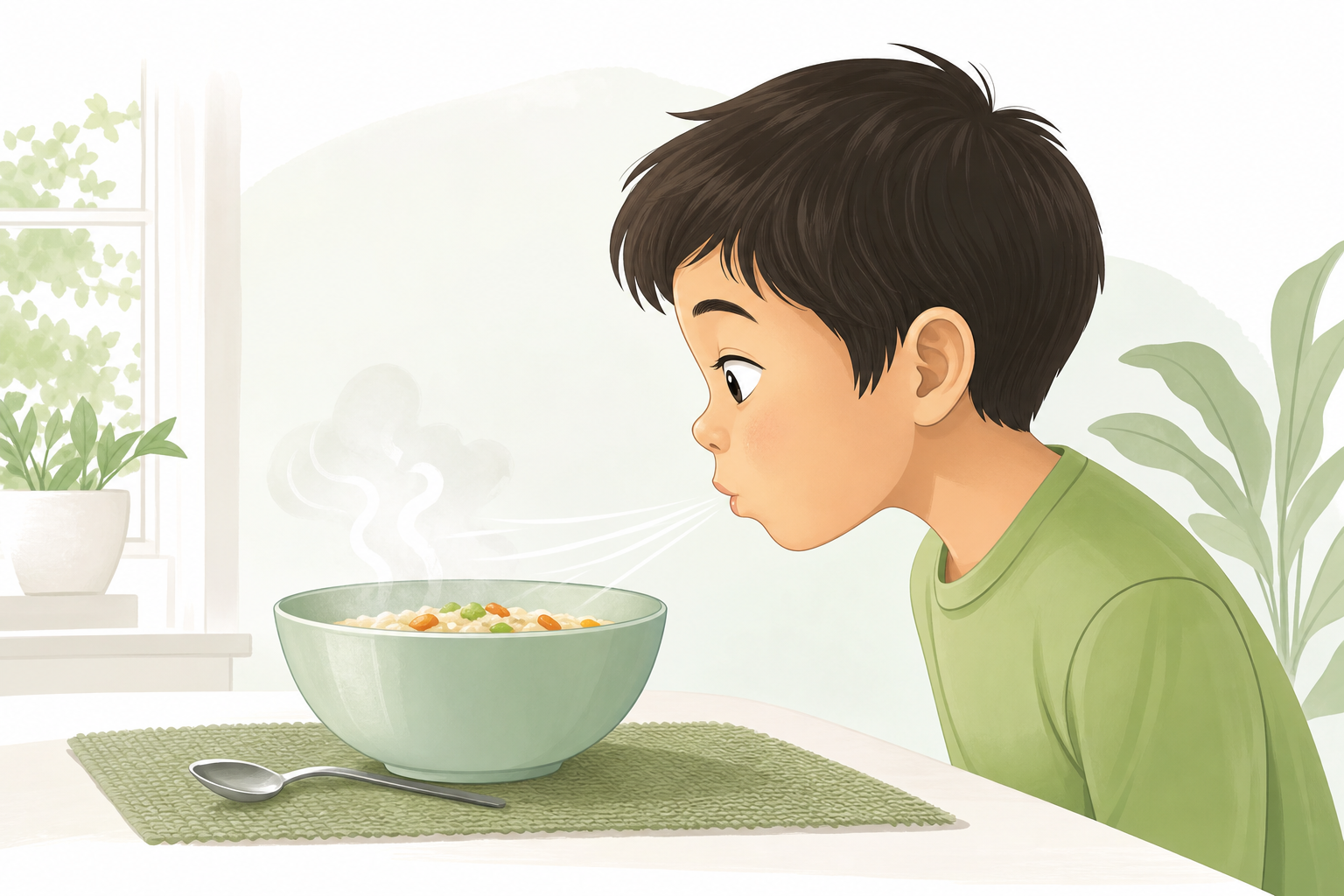
When you blow on hot food, the cooling is significantly enhanced by two key processes: evaporation and convection. This action can notably accelerate the cooling, allowing you to enjoy your meal sooner without the risk of burns.
Blowing on hot food enhances the cooling effect by facilitating evaporation and convection, increasing heat loss while replacing warm air with cooler air, which leads to a quicker cooling process.
In One Sentence
Blowing on hot food enhances the cooling effect by facilitating evaporation and convection, increasing heat loss while replacing warm air with cooler air, which leads to a quicker cooling process.

Original AI-generated educational image for Why Science Daily.
The Mechanism in Motion
The cooling effect observed when blowing on hot food is largely attributed to evaporation and convection. In a static environment, a blanket of warm air forms around hot food, acting as an insulator and slowing down the cooling process. By blowing on the food, you disturb this warm air layer, allowing cooler air to surround the food more effectively.
Convection, the process of heat transfer through the movement of fluids, is crucial here. Blowing generates airflow that circulates cooler air across the hot surfaces of the food, facilitating greater heat loss to the surrounding environment. As the warm air is expelled, efficient convection occurs, leading to quicker temperature drops.
Simultaneously, evaporation plays a vital role. Hot food typically has moisture on its surface that evaporates quickly at higher temperatures. When you blow on the food, you increase the evaporation rate of this moisture, which cools the food not only from the heat it carries away directly but also by utilizing the cooling properties of the new vapor. This efficient combination of convection and evaporation illustrates why blowing on food can produce a noticeable cooling effect.
The interplay between these two scientific principles explains why simply allowing food to sit can feel like a long wait. It's the disruption of stagnant air and the promotion of heat exchange that shortens the wait time, illustrating the tangible application of thermal dynamics in everyday life.
To deepen understanding, consider how these principles scale down to the microscopic level: the warm molecules of air surrounding the hot food may seem insubstantial, but they create a significant insulating barrier. When you blow, you introduce motion and larger temperature gradients, amplifying cooling efficiency. This connection between visible patterns and underlying science is fundamental in grasping how everyday actions can be scientifically explained.
A practical manifestation of these principles can be seen when cooking: if hot food is disturbed, the immediate effect on its cooling becomes evident, offering valuable insights into thermal dynamics in the kitchen. Observing this can serve as an educational moment for all, showcasing a fascinating blend of practical cooking and scientific application.

Original AI-generated educational image for Why Science Daily.
A Real-World Lens
Consider the scenario of preparing a steaming bowl of oat porridge. Attempting to eat it immediately risks burns. When you blow across the surface, you witness steam dissipate rapidly, and within moments, the porridge reaches a comfortable temperature suitable for eating. This method also applies when savoring a hot cup of soup on a cold day or allowing freshly baked cookies to cool. In each case, blowing serves to manage the heat and steam, expediting the time it takes to enjoy your meal. Allowing hot food to sit can prolong the waiting experience, as warm air surrounding the food slows down the cooling process, adding more time to your meal preparation.
For parents, teaching children this blowing technique not only helps cool meals efficiently but also incorporates a fun lesson in science, showcasing how simple actions relate to cool physical principles.

Original AI-generated educational image for Why Science Daily.
Myth Check
One prevalent misconception is that blowing on hot food is solely about introducing colder air. This is only partially accurate. The cooling effect comes predominantly from the increase in heat transfer driven by evaporation and the disruption of the insulating layer of warm air. Additionally, mixing food with utensils does not enhance evaporation as effectively as blowing does; while stirring can help even out temperature, it fails to replicate the focused cooling benefit achieved through the forced evaporation caused by blowing.
The effectiveness of blowing also depends on the type of food. High-moisture foods, like soups and sauces, will experience a more pronounced cooling effect due to their ability to evaporate more moisture compared to solid foods. This distinction clarifies why blowing is more beneficial in some cooking scenarios than in others.
Furthermore, some might think that using devices like fans would yield better cooling results, but this is misleading. While fans generate airflow, they lack the effect of directly replacing warm air with cooler air at nearly the same point, diminishing their effectiveness compared to blowing directly on the food.
The Main Idea to Keep
By blowing on hot food, you effectively accelerate its cooling through enhanced convection and evaporation. This simple yet effective technique illustrates the principles of thermal dynamics in everyday cooking, making for a safer and more enjoyable dining experience.
What Changes the Outcome
| Part | Focus | What to remember |
|---|---|---|
| Main idea | hot food | The cooling effect observed when blowing on hot food is largely attributed to evaporation and convection. In a static environment, a blanket… |
| Common mistake | Misconception | One prevalent misconception is that blowing on hot food is solely about introducing colder air. This is only partially accurate. The cooling… |
| Everyday takeaway | Practical meaning | By blowing on hot food, you effectively accelerate its cooling through enhanced convection and evaporation. This simple yet effective techni… |
Useful Questions
Why does blowing cool food faster than just letting it sit?
Blowing disrupts the insulating layer of warm air surrounding the food and promotes both quicker convection and increased evaporation, enabling faster cooling.
Is it effective for all types of food?
Blowing is particularly effective for foods with high moisture content, like soups. Solid foods may not see the same dramatic cooling effect.
Do fans work better than blowing on food?
While fans increase airflow, they may not replace warm air as directly as blowing does, which limits their effectiveness in rapidly cooling food.
Can stirring food cool it as well?
Stirring helps mix temperatures but doesn’t significantly enhance evaporation like blowing does, so it’s not as effective for quick cooling.
What role does moisture play in this process?
Moisture on the food’s surface is critical; it evaporates when the food is hot, carrying heat away. Blowing accelerates this evaporation.
Source Notes
- Evaporative Cooling of Food
- Does a Fan Really Cool the Air?
- Soup's Ready!
- Blow Hot; Blow Cold
- Why Does Blowing put out a Flame?
Originality notice: This article is published by Why Science Daily. Please cite and link to the original page when referencing this content.
Keywords: hot food, evaporation, convection, heat transfer, cooling, thermal dynamics, kitchen science, cooking techniques