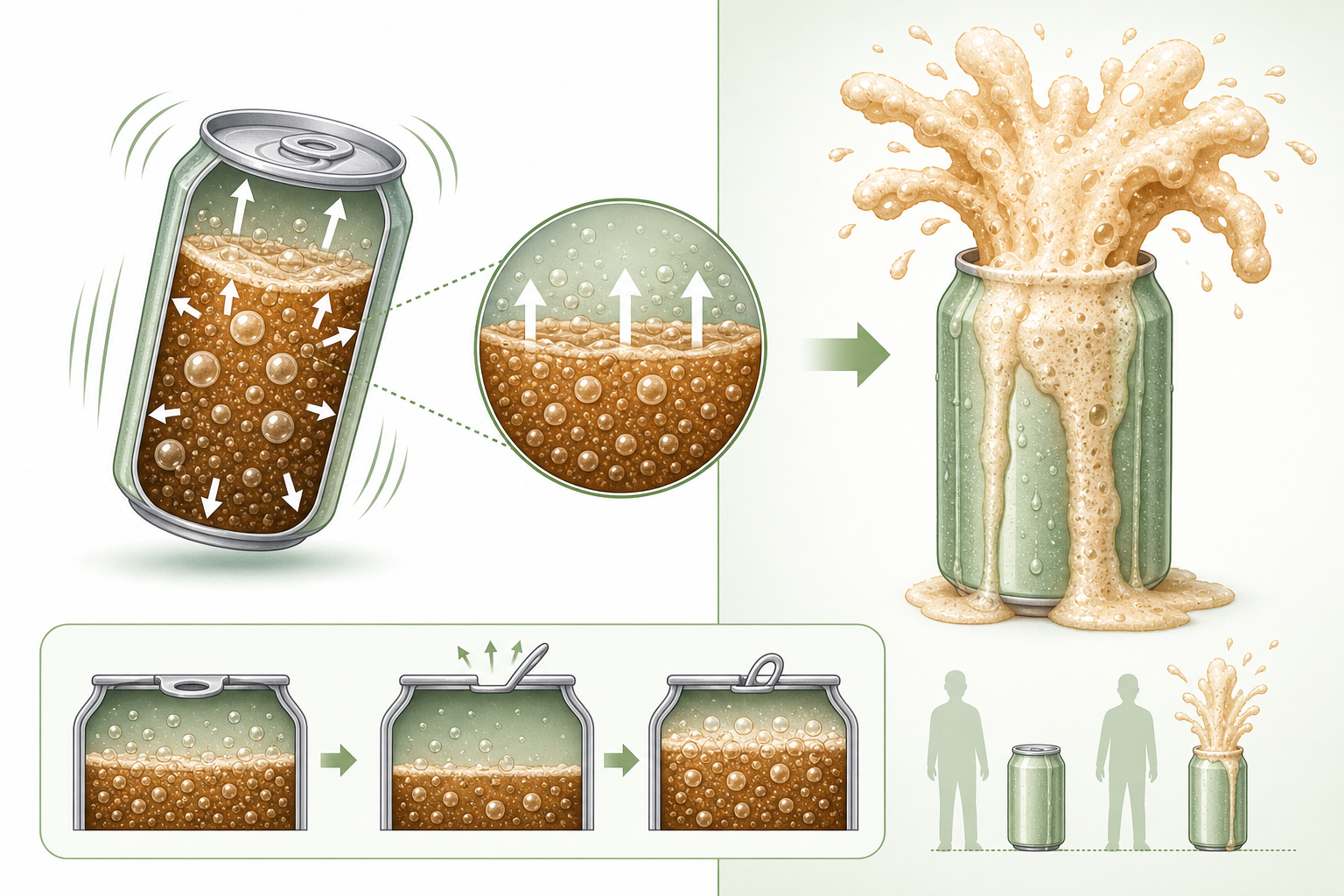
Soda often erupts dramatically after being shaken due to the rapid release of carbon dioxide (CO2) gas that has been dissolved under pressure. Understanding the underlying physics and chemistry of this phenomenon can illustrate the fascinating interaction between pressure changes and gas dynamics in our everyday lives.
When a soda can is shaken, internal pressure rises as bubbles form from dissolved carbon dioxide. Upon opening, the pressure drops abruptly, allowing these bubbles to expand immediately and overflow the beverage. This reaction is primarily attributed to a process called nucleation.
In One Sentence
When a soda can is shaken, internal pressure rises as bubbles form from dissolved carbon dioxide. Upon opening, the pressure drops abruptly, allowing these bubbles to expand immediately and overflow the beverage. This reaction is primarily attributed to a process called nucleation.

Original AI-generated educational image for Why Science Daily.
The Mechanism in Motion
Shaking a can of soda initiates a complex interplay of physical reactions, primarily driven by the behavior of gas under pressure. Normally, carbon dioxide is kept dissolved in the liquid at high pressure, which maintains its stability. When shaken, the agitation introduces air and modifies local pressure, leading to the rapid formation of multiple small bubbles. This is where nucleation comes into play, as CO2 molecules gather around tiny imperfections on the can's interior or within the liquid itself, creating nucleation sites.
As the shaking continues, gas bubbles form, multiplying rapidly. Once the can is opened, the pressure inside drops significantly, allowing the trapped gas to escape. This escape causes the bubbles to expand aggressively, producing a cascading effect where bubbles combine to create larger ones, resulting in the soda being violently expelled from the can.
Warm sodas exacerbate this explosive reaction. Higher temperatures increase molecular kinetic energy, making it easier for carbon dioxide to escape once the can is opened. Consequently, a can shaken at room temperature is significantly more prone to fizzing than one stored cold. Understanding these interactions requires insight into fluid dynamics and thermodynamics, particularly concerning how gases behave depending on external pressure.
Visualizing the scenario can help clarify these processes: consider the soda akin to a tightly sealed balloon. Shaking the can disturbs this balance, adding energy to the system, which results in a sudden release of that potential energy when opened—a phenomenon perceived as a fizzy eruption. It is crucial to recognize that this is a physical occurrence rather than a chemical one; the core composition of the soda remains unchanged intentionally.
In summary, the interaction between agitation (shaking), the formation of nucleation sites, and pressure fluctuations works together to produce the explosive flow we associate with opened soda cans. Appreciating these relationships through scientific inquiry enhances our understanding of everyday occurrences like soda explosions.
To test these insights, consider what would change if the soda were shaken, warmed, or otherwise altered. The relationship between nucleation and the resultant overflow reveals the mechanism behind the phenomenon without needing intricate formulas. A thorough examination often involves contrasting typical outcomes with the near-misses or failures that highlight underlying principles.
Many people perceive soda merely as a single object or event, but the dynamics rely on considerable factors—shape, load balance, pressure, and temperature distribution within the system. Recognizing and analyzing these aspects can demystify seemingly straightforward phenomena, showing that the familiar outcomes stem from several components operating in unison.

Original AI-generated educational image for Why Science Daily.
A Real-World Lens
Picture a family gathering where exuberant kids are present. You shake a soda can, anticipating a fun surprise. However, when you open it, the soda erupts, showering everyone nearby! This scenario exemplifies nucleation dynamics, showcasing how even slight agitation can lead to a fizzy overflow.
In a grocery store, employees must exercise caution when handling soda cans, as rough transport can lead to pressure accumulation. They may suspect a shaken can and let it sit for a while to avoid an untimely explosion, demonstrating practical knowledge of nucleation effects.
For a simple home experiment, take a clear plastic bottle filled with soda. After shaking it lightly, observe the spectacular foaming when you reopen it; this acts as a clear demonstration of nucleation in action, showcasing how pressure leads to the delightful (yet messy) eruption we associate with soda cans.

Original AI-generated educational image for Why Science Daily.
Myth Check
A prevalent misconception is that shaking soda triggers a chemical reaction leading to an explosion upon opening. In truth, this is a purely physical reaction; no new substances are formed, and the carbon dioxide required for carbonation was already present. Another widespread myth claims that tapping a shaken can before opening it helps minimize mess. While tapping might redistribute gas bubbles slightly, it does not effectively alleviate the pressure created by shaking. Allowing the can to sit for a few minutes is the best way to stabilize the bubbles before opening.
The Main Idea to Keep
Grasping the science behind soda explosions when shaken involves understanding the interplay of factors such as pressure, nucleation, and gas expansion. These principles highlight that the phenomena we experience daily often stem from intricate, underlying interactions. Next time you're about to enjoy a soda, remember that a gentle handle can prevent a fizzy mishap!
What Changes the Outcome
| Part | Focus | What to remember |
|---|---|---|
| Main idea | soda | Shaking a can of soda initiates a complex interplay of physical reactions, primarily driven by the behavior of gas under pressure. Normally,… |
| Common mistake | Misconception | A prevalent misconception is that shaking soda triggers a chemical reaction leading to an explosion upon opening. In truth, this is a purely… |
| Everyday takeaway | Practical meaning | Grasping the science behind soda explosions when shaken involves understanding the interplay of factors such as pressure, nucleation, and ga… |
Useful Questions
Why does shaking soda make it fizz?
Shaking generates numerous tiny bubbles from dissolved carbon dioxide. When the can is opened, these bubbles rapidly expand, leading to uncontrollable fizzing and potential overflow.
Can temperature affect a shaken soda's explosion?
Yes, warmer sodas possess higher kinetic energy, facilitating the escape of gas. Consequently, a warm can typically fizzes more violently than a colder one due to increased pressure internal.
Is there a way to reduce mess from a shaken soda before opening it?
To minimize the fizz, allow the soda to settle for a few minutes after shaking. Although tapping the can might help redistribute bubbles, it doesn't significantly reduce internal pressure.
What are nucleation sites?
Nucleation sites are tiny imperfections within surfaces or liquids that facilitate bubble formation. In soda, these sites enable the rapid growth of bubbles during shaking.
Does shaking a soda alter its taste?
While shaking doesn’t change the soda's chemical makeup, it can influence the taste experience through changes in carbonation levels, making it feel different when consumed.
Source Notes
- Volcano Watch — The Soda Can Analogy for Kīlauea's Current Summit Eruption
- Volcano Watch — Bottled soda helps us to understand volcanic eruptions
- Mentos Explosion
- FAQ: Mentos and Other Explosions
- Liquid Nitrogen Trash Can | Harvard Natural Sciences Lecture Demonstrations
Originality notice: This article is published by Why Science Daily. Please cite and link to the original page when referencing this content.
Keywords: soda, carbon dioxide, bubbles, pressure, nucleation, explosion, fizz, soda science, gas expansion