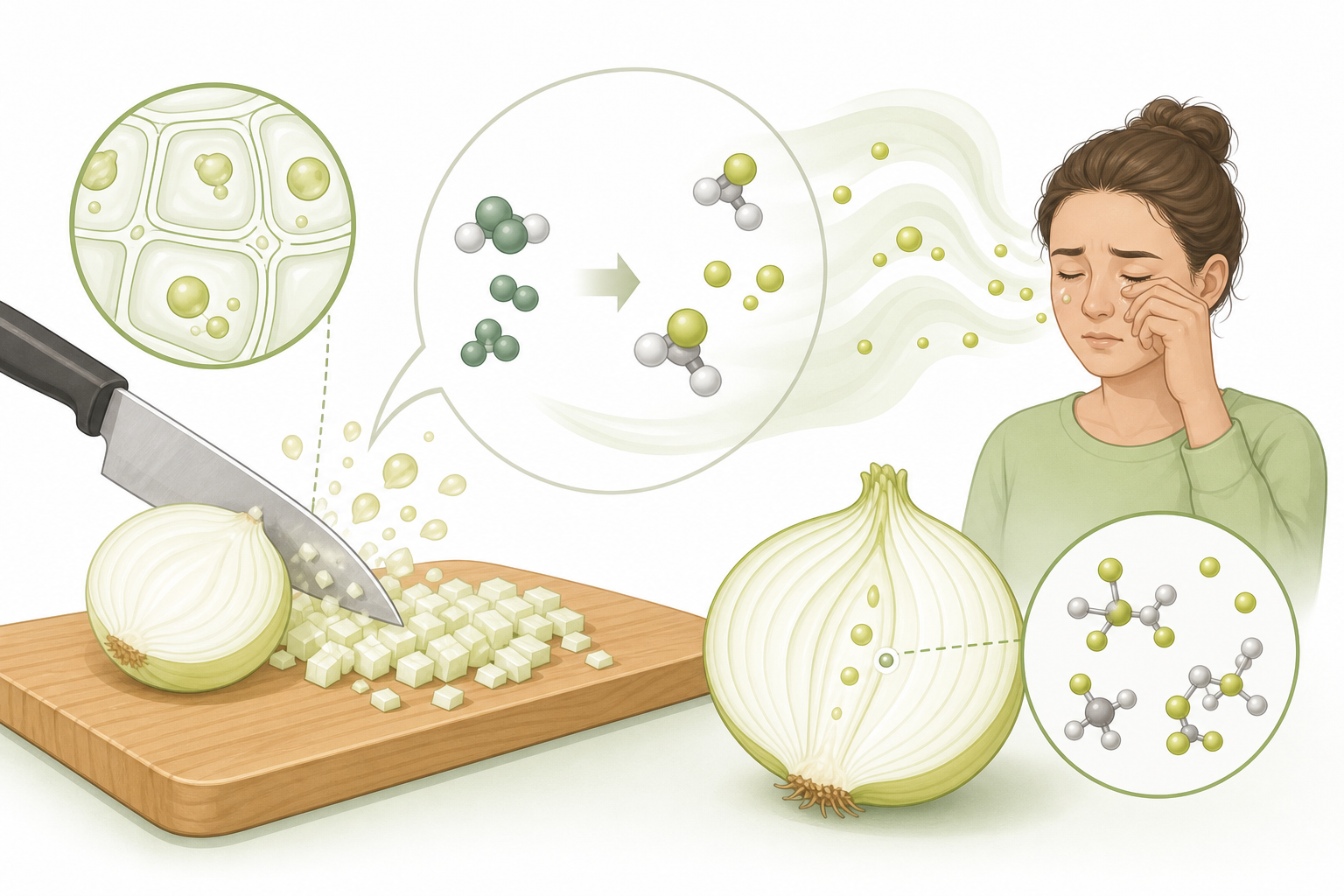
Onions are notorious for making us cry during chopping, and this phenomenon is rooted in chemistry. When an onion is sliced, it releases volatile sulfur compounds that convert into sulfenic acid due to an enzymatic reaction involving alliinase. This compound can irritate our eyes, resulting in tears as a protective measure. By understanding these interactions, we gain insight into both the chemistry of food and our sensory responses.
Cutting onions releases volatile sulfur compounds that irritate the eyes and elicit a tearing response due to the conversion of specific compounds through the enzyme alliinase.
Start With the Answer
Cutting onions releases volatile sulfur compounds that irritate the eyes and elicit a tearing response due to the conversion of specific compounds through the enzyme alliinase.

Original AI-generated educational image for Why Science Daily.
Begin With an Everyday Example
Picture a chef preparing a classic onion soup. As they begin to chop, their eyes immediately water, momentarily disrupting their cooking rhythm. This scenario plays out regularly in kitchens, leading many to try various tricks to cope—like wearing goggles, chewing gum, or using a fan to blow the fumes away. Such adaptations highlight routine strategies employed by cooks to manage the discomfort linked to onion cutting.
In culinary schools, instructors demonstrate techniques to minimize tearing while maximizing flavor. Students learn the benefits of sharp knives, which allow for cleaner cuts and reduced sulfur release. Gaining these skills not only enhances the culinary experience but also renders it more enjoyable for aspiring chefs.
For individuals particularly sensitive to tearing, appliance solutions like onion choppers or food processors may offer relief from direct contact with sulfur compounds. There is a unified understanding in both home and professional kitchens that grasping the chemistry behind onion-induced tears empowers cooks to adopt efficient methods conducive to both ease and flavor enhancement.

Original AI-generated educational image for Why Science Daily.
Follow the Science Step by Step
The act of slicing an onion is a prime example of chemistry occurring in real time. When onions are cut, the enzyme alliinase reacts with sulfur-containing amino acids present in onion cells to produce sulfenic acid. This compound is highly volatile, meaning it evaporates quickly into the air. Upon reaching our eyes, it interacts with the moisture in the air to form sulfuric acid. Although this acid is present in very small quantities, it is sufficient to provoke irritation. This irritation triggers the eye's natural defense mechanism: tearing up to flush out the irritants.
Onion varieties significantly influence the intensity of this reaction. Pungent onions like Yellow and Red varieties often have higher levels of sulfur compounds compared to sweeter onions such as Vidalia, which contain fewer irritating substances. This explains why certain onions are preferred in cooking; chefs select them not just for flavor but also for their tear-inducing properties.
Additionally, when the body produces tears while cutting onions, the teardrops serve a dual purpose. They not only help eliminate the irritants but also recharge the surface of the eye, fostering comfort and enhanced visibility. This reflexive response is a vital mechanism through which our body defends itself from potential harm.
In practical terms, understanding the chemistry of tearing has implications for culinary practices. Many chefs advise chilling onions before cutting to slow down the enzymatic reaction and reduce sulfur release. Other recommended techniques include using a sharp knife to minimize cell damage and cutting under water to prevent the volatile compounds from dispersing into the air. Such strategies can greatly benefit individuals who are particularly sensitive to tearing.
By examining how sulfur compounds affect our eyes when cutting onions, we can appreciate the interaction of physical conditions at play. The correlation isn't merely one-dimensional; multiple factors contribute to the overall experience of crying while cutting onions. The science can sometimes seem less dramatic than expected, but it offers a more trustworthy understanding of the phenomenon.
Exploring the scale of this process reveals much about the behavior of the onion's sulfur compounds. Despite their seemingly harmless release, the combination of irritation and our eye's physical response underscores the interconnectedness of food chemistry and human biological responses. Careful analysis, rather than superficial conclusions, provides deeper insight into why we react the way we do when handling onions.

Original AI-generated educational image for Why Science Daily.
A Tempting but Incomplete Explanation
It's a common misconception that all onions cause the same amount of tearing when cut. In fact, the concentration of sulfur compounds varies significantly across onion varieties. Some individuals erroneously believe that the tears produced by onions are harmful, but these tears are a protective reaction, essential for eye health. Furthermore, some think that merely the smell of onions causes tearing; however, it is the chemical reactions that generate irritation.
Another myth is that specific cutting techniques can entirely prevent tears. While methods like using a sharp knife can lessen irritation, they do not guarantee complete avoidance of a tear reaction since chemical reactions can still occur, albeit at lower levels. Additionally, many fail to recognize that even cooked onions can induce tears if not handled correctly. Caramelization changes the nature of sulfur compounds, but these substances are not completely eliminated.
Understanding that tearing is a natural defense mechanism can help mitigate feelings of frustration while preparing food. Not all experiences are the same; indeed, individual sensitivity varies widely, which explains some people's greater susceptibility to tearing than others.
The Practical Conclusion
Understanding the chemical reactions responsible for crying when cutting onions can change how you approach food prep. By recognizing the role of sulfur compounds and employing effective cutting techniques, you can enjoy cooking while minimizing tears. Next time you handle an onion, you'll not only appreciate its flavor but also the intriguing science behind it.
Mechanism at a Glance
| Part | Focus | What to remember |
|---|---|---|
| Main idea | onions crying | The act of slicing an onion is a prime example of chemistry occurring in real time. When onions are cut, the enzyme alliinase reacts with su… |
| Common mistake | Misconception | It's a common misconception that all onions cause the same amount of tearing when cut. In fact, the concentration of sulfur compounds varies… |
| Everyday takeaway | Practical meaning | Understanding the chemical reactions responsible for crying when cutting onions can change how you approach food prep. By recognizing the ro… |
Common Follow-Up Questions
Why do some onions make me cry more than others?
Different onion types contain varying concentrations of sulfur compounds. Pungent varieties, like Yellow onions, have higher levels, while sweeter varieties, like Vidalia, have less, causing fewer tears.
Can cooking onions prevent tears?
Cooking alters the sulfur compounds in onions, reducing their potential for irritation. Caramelized onions typically release fewer sulfur compounds, making them less likely to induce tearing.
Is there a way to cut onions without crying?
Yes! Techniques like using a sharp knife, chilling the onions beforehand, or cutting them under running water can minimize sulfur release and reduce eye irritation.
Are the tears from cutting onions harmful?
No, the tears produced while cutting onions are a natural reaction to irritation, helping to defend the eyes by flushing out irritants.
What role do our eyes play when slicing onions?
Our eyes react to sulfur compounds emitted by onions by producing tears. This action helps remove irritants, maintaining eye comfort and clarity.
References Used for This Explanation
- Undergraduate student and faculty member explain research on why onions make you cry
- Onions: Why do they make us cry?
- Curiosities: Why do onions make us cry when we cut them?
- Cooking with Onions without Crying
- The nitty-gritty behind how onions make you cry
Originality notice: This article is published by Why Science Daily. Please cite and link to the original page when referencing this content.
Keywords: onions crying, sulfur compounds, eyes, tears, chemistry, volatile compounds, onion enzyme, irritation