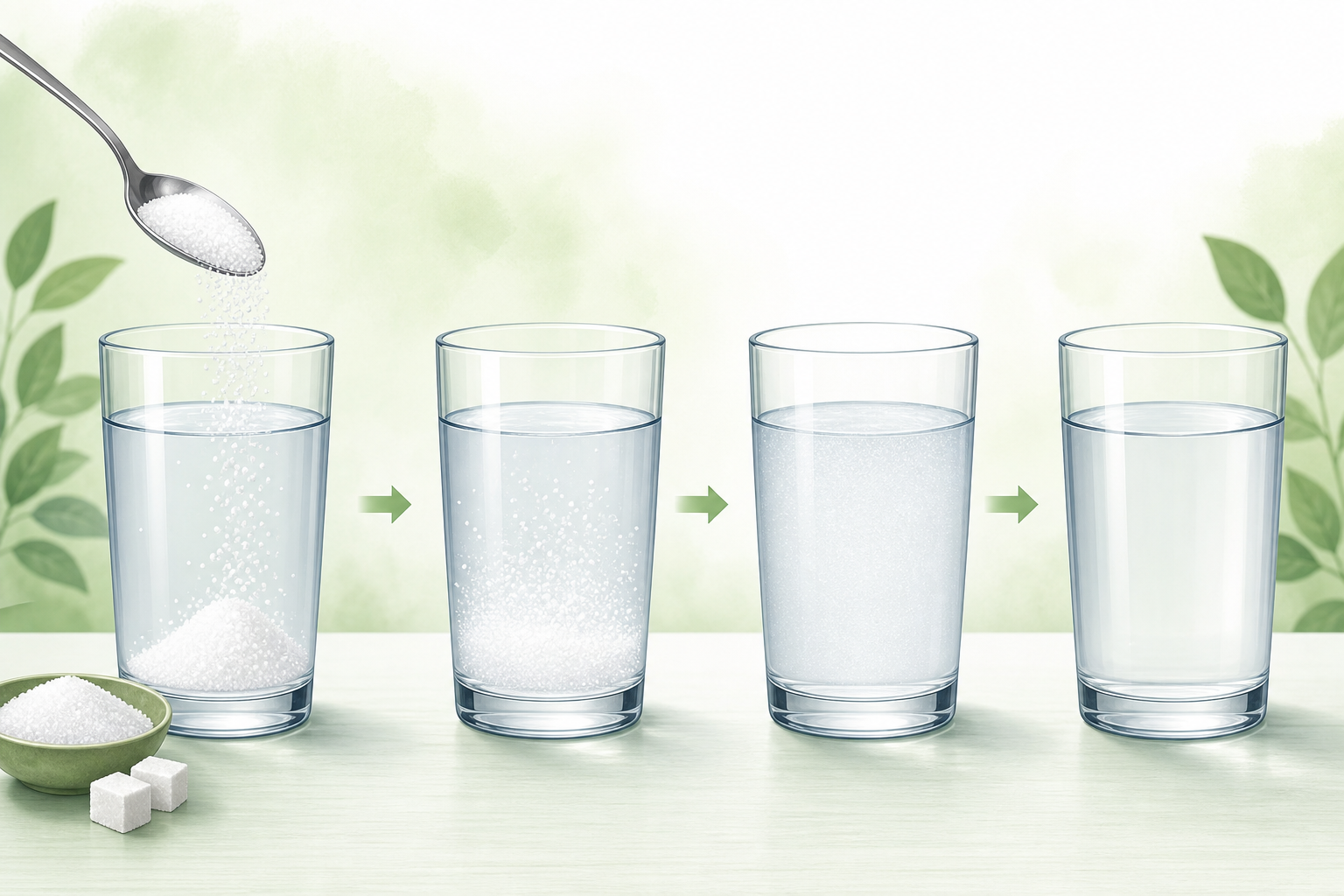
Water is an exceptional solvent due to its unique molecular properties, which allows it to effectively dissolve sugar. When sugar is added, water's polar molecules interact with sugar's structure, breaking it apart and allowing the sweet flavor to be released. This phenomenon reveals important aspects of chemistry that are crucial for our everyday food and beverage experiences.
The Bottom Line
When sugar is added to water, the polar molecules of water surround and interact with sugar molecules, causing them to separate and dissolve. This process is what makes sugar taste sweet when dissolved in drinks or food.

Original AI-generated educational image for Why Science Daily.
Why the First Guess Falls Short
A prevalent misconception is that sugar simply melts in water, which overlooks the complexity involved in dissolution. Melting and dissolving are fundamentally different processes. While melting involves changing from solid to liquid states physically, dissolving requires breaking molecular bonds to disperse particles evenly in a solvent.
Another misconception is that all substances dissolve in water in similar ways. The principle 'like dissolves like' holds true: polar substances, such as sugar and salt, dissolve well in polar solvents like water, while non-polar substances, such as oil, do not mix. Understanding these distinctions helps clarify the differing behaviors of various materials in solutions, emphasizing the importance of molecular structure in predicting solubility.

Original AI-generated educational image for Why Science Daily.
How the Mechanism Actually Works
The dissolution of sugar in water centers on the concept of solubility, which describes how well a solute, like sugar, can disperse in a solvent, in this case, water. Sugar, or sucrose, is a crystalline compound made of carbon, hydrogen, and oxygen atoms. The molecular structure and polar nature of water play a significant role in how sugar dissolves.
Water is unique due to its V-shaped molecule, with one oxygen atom bonded to two hydrogen atoms. This structure creates a polarity where one end (hydrogen) has a partial positive charge and the other end (oxygen) has a partial negative charge. This charge separation allows water to effectively interact with other polar substances, such as sugar.
When sugar is introduced to water, the positive hydrogen ends of the water molecules are attracted to the negatively charged parts of the sugar molecules. Conversely, the negative end of the water molecules clusters around the positively charged areas of sugar. This attraction disrupts the forces holding sugar molecules together in their solid form, leading to their dissolution in water.
As sugar dissolves, water molecules surround individual sugar molecules, breaking the intermolecular forces that keep them bonded in solid form. This process is not merely mixing; chemical processes are involved, allowing for dynamic interactions between the sugar and water.
The saturation point is crucial to the understanding of this process. There exists a limit to how much sugar can dissolve in water at a given temperature. Once the solution reaches saturation, any excess sugar will not dissolve and will settle at the bottom. Temperature plays a key role in this dynamic; higher temperatures increase the kinetic energy of water molecules, speeding up interactions with sugar. This is why you see sugar dissolve quickly in hot beverages compared to cold ones, as colder water molecules move less vigorously and may not interact as effectively with sugar.

Original AI-generated educational image for Why Science Daily.
Where You Can See It
An everyday scenario of sugar dissolving in water occurs when sweetening coffee or tea. Adding sugar to hot liquids leads to rapid dissolution due to increased molecular movement, enhancing the beverage's taste. In contrast, adding sugar to cold water without stirring may leave granules visible at the bottom, showing how temperature affects the rate of dissolution.
In baking, sugar’s role extends beyond adding sweetness. It contributes to moisture retention and textural qualities in baked goods. When sugar is incorporated into dough, it interacts chemically, influencing properties like rise, texture, and even shelf-life. Properly dissolved sugar is key to achieving soft, moist products, while excessive sugar can lead to undesirable graininess, impacting the quality of the final baked good. Understanding these processes is essential for both culinary success and appreciating the science behind it.
What to Remember
Grasping how water dissolves sugar enriches our appreciation of the molecular interactions that underpin our food experiences. Recognizing the chemistry involved allows us to better understand not only cooking and baking but also how we enjoy flavors in our daily lives.
Compare the Ideas
| Part | Focus | What to remember |
|---|---|---|
| Main idea | water dissolving sugar | The dissolution of sugar in water centers on the concept of solubility, which describes how well a solute, like sugar, can disperse in a sol… |
| Common mistake | Misconception | A prevalent misconception is that sugar simply melts in water, which overlooks the complexity involved in dissolution. Melting and dissolvin… |
| Everyday takeaway | Practical meaning | Grasping how water dissolves sugar enriches our appreciation of the molecular interactions that underpin our food experiences. Recognizing t… |
Questions Readers Ask
Why does sugar dissolve faster in hot water?
Sugar dissolves more quickly in hot water due to increased energy levels. Higher temperatures enable water molecules to move more rapidly, enhancing their interactions with sugar, which helps break it apart more efficiently.
Can all types of sugar dissolve in water?
Many sugars, including sucrose and glucose, dissolve easily in water. However, some sugar alcohols and certain other compounds have lower solubility because their molecular structures impact how they interact with water.
What other substances can dissolve in water?
Other polar substances, such as salt, acids, and various food components like coffee grounds, can dissolve in water. The solubility of a substance depends significantly on its polarity and interaction characteristics.
Does temperature affect the solubility of sugar?
Yes, temperature significantly impacts sugar solubility. Hot water can dissolve more sugar than cold water because the increased thermal energy leads to more vigorous molecular movement and effective interactions.
What happens when too much sugar is added to water?
When excess sugar is added to water, the solution reaches saturation, meaning no additional sugar can dissolve. The undissolved sugar will settle at the bottom of the container, explaining why we see granules remaining.
Why is sugar important in baking?
Sugar is vital in baking, providing sweetness along with contributing to moisture retention, texture, and flavor. Its ability to dissolve and interact with other ingredients affects rise, crumb structure, and overall quality of baked products.
Evidence and Further Reading
- Solubility
- Mixing Sugar and Water
- Water Solubility
- 12.1 The Dissolution Process – Chemistry Fundamentals
- CH150: Chapter 7 – Solutions – Chemistry
Originality notice: This article is published by Why Science Daily. Please cite and link to the original page when referencing this content.
Keywords: water dissolving sugar, sugar solubility, chemical interactions, taste perception, molecular bonding, solutions, cooking science, temperature effects