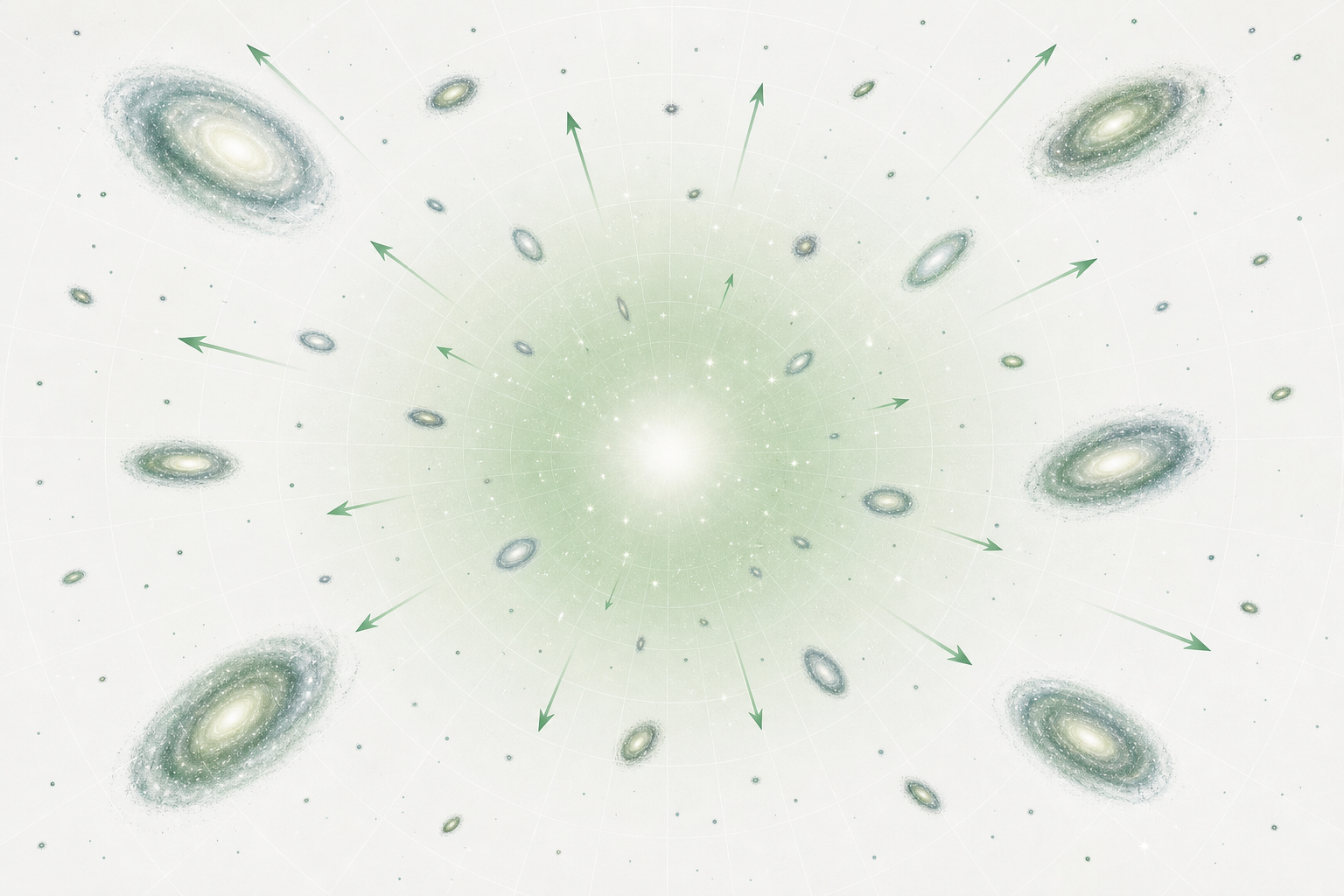
The universe is expanding due to a phenomenon known as cosmic expansion, primarily driven by dark energy. This means that galaxies are moving away from each other as space itself stretches. As scientists delve deeper into the cosmos, they uncover intriguing mechanisms behind this expansion, illuminating our understanding of the universe.
- What the answer comes down to for universe expansion
- A concrete example around universe expansion
- Where the usual explanation breaks inside universe expansion
- The cause-and-effect chain under universe expansion
- The reader-friendly summary for universe expansion
- Side-by-Side View: Universe Expansion
- What People Often Ask: Universe Expansion
- More Source-Checked Science: Universe Expansion
- Sources and Further Reading: Universe Expansion
What the answer comes down to for universe expansion
The expansion of the universe is caused by dark energy, which acts as a force pushing galaxies apart. This phenomenon was first identified through observations of the redshift of light from distant galaxies, indicating they are moving away from us.

Original AI-generated educational image for Why Science Daily.
A concrete example around universe expansion
To better visualize the universe's expansion, consider an inflating balloon. As air fills the balloon, its surface expands, and if you had dots on that surface, they would gradually move away from each other. The scenario mirrors the cosmic landscape, where galaxies are not simply moving through space; rather, the very fabric of space is expanding, pushing them apart. Scientists utilize this analogy to explain the expansion phenomenon clearly, aiding our collective understanding.
The implications of cosmic expansion also extend to our observation of the night sky. As the universe expands, the positions of stars and galaxies change over long time scales. In millions of years, certain stars may become unreachable because they drift beyond our observable horizon. This constant movement impacts not only our understanding of the cosmos but also potential astronomical discoveries for future generations. For instance, many celestial observations made today may become inaccessible in the distant future, crafting a narrative of a continually evolving universe. Observational evidence indicates that the faintest galaxies dwindle as they recede, altering the fabric of our night sky over eons. Thus, the expansion of the universe affects not only the layout of cosmic objects but also humanity's journey in uncovering the universe's mysteries.

Original AI-generated educational image for Why Science Daily.
Where the usual explanation breaks inside universe expansion
A prevalent misconception about the universe's expansion is that it suggests galaxies are moving through space away from each other. In reality, space itself is expanding. An analogy often used is that of dots on an inflating balloon. As the balloon swells, the dots do not move across the surface; instead, the surface itself is stretching, causing the dots to move apart. This is a foundational principle of cosmology that clarifies how galaxies' movements are not merely spatially driven but are the result of the very fabric of space expanding.
Another common misunderstanding is related to dark energy's nature. Many people assume dark energy is a tangible form of energy, like the fuel that powers a car. In truth, dark energy remains largely theoretical. It is characterized not by its physical manifestation but by the effects it exerts on the universe on a massive scale. Current models describe dark energy principally through its influence on cosmic expansion, necessitating further research to fully unravel its characteristics and implications. This lack of concrete understanding leads to confusion about the role it plays in cosmic dynamics, reflected in various hypotheses but no definitive answers as of now.

Original AI-generated educational image for Why Science Daily.
The cause-and-effect chain under universe expansion
The concept of the universe's expansion stems from the widely accepted Big Bang theory, which posits that the universe originated from an incredibly hot, dense state about 13.8 billion years ago. Initially, the universe expanded rapidly, cooling enough for particles to form atoms. Over time, these atoms formed stars and galaxies, shaping the vast cosmos we observe today.
This expansion is quantified by Hubble's Law, formulated by Edwin Hubble in the 1920s. Hubble calculated that the farther away a galaxy is, the more quickly it recedes from us. This observation supports the idea of a uniformly expanding universe, akin to dots on a balloon's surface moving farther apart as the balloon inflates.
Dark energy is thought to constitute approximately 68% of the total energy content of the universe. It was first identified in the late 1990s through studies of Type Ia supernovae, which revealed that the rate of expansion was not just constant but accelerating. Dark energy acts as a repulsive force that counterbalances the attractive force of gravity, driving galaxies apart in the process. The exact nature of dark energy remains a mystery, challenging researchers to explore potential theories including modifications of general relativity or new physics.
One pivotal moment in understanding cosmic expansion is the phenomenon of cosmic inflation, which occurred just fractions of a second after the Big Bang. During inflation, the universe underwent an exponential expansion, smoothing out irregularities and setting the stage for the uniform structure of galaxies today. This rapid inflationary phase explains the relative homogeneity of the cosmic microwave background radiation that permeates our universe, serving as residual evidence of the Big Bang.
Understanding the implications of an expanding universe reshapes our grasp of gravity and the ultimate fate of cosmic structures. If the current rate of expansion continues, many galaxies will eventually drift beyond our observable horizon, resulting in a darker universe inhabited only by increasingly isolated galactic groups over billions of years.
The reader-friendly summary for universe expansion
The expansion of the universe is a profound aspect of modern cosmology, primarily driven by dark energy and the remnants of the Big Bang. This ongoing phenomenon not only shapes our understanding of cosmic dynamics but also hints at an ever-changing universe, beckoning future exploration and contemplation.
Side-by-Side View: Universe Expansion
| Part | Focus | What to remember |
|---|---|---|
| Main idea | universe expansion | The concept of the universe's expansion stems from the widely accepted Big Bang theory, which posits that the universe originated from an in… |
| Common mistake | Misconception | A prevalent misconception about the universe's expansion is that it suggests galaxies are moving through space away from each other. In real… |
| Everyday takeaway | Practical meaning | The expansion of the universe is a profound aspect of modern cosmology, primarily driven by dark energy and the remnants of the Big Bang. Th… |
What People Often Ask: Universe Expansion
What is dark energy?
Dark energy is a mysterious force contributing to the accelerated expansion of the universe, encompassing roughly 68% of its energy density. Its characteristics remain largely theoretical, inferred from its impact on cosmic phenomena.
How do we observe the universe expanding?
Scientists observe the expansion of the universe through redshift measurements. As galaxies recede, their light shifts toward the red end of the spectrum, providing crucial evidence for ongoing cosmic expansion.
What does Hubble's Law state?
Hubble's Law states that the recessional velocity of galaxies is directly proportional to their distance from Earth, confirming the universe's uniform expansion at varying scales.
What role did the Big Bang play in expansion?
The Big Bang initiated the universe's expansion, laying the groundwork for all cosmic matter and energetic transformations, which continue to influence the cosmos.
Will the universe continue expanding forever?
Current research suggests that unless dark energy's properties change, the universe will likely continue expanding indefinitely, posing intriguing questions about its long-term fate.
Sources and Further Reading: Universe Expansion
- How does the universe work? – NASA Science
- What is Dark Energy? Inside Our Accelerating, Expanding Universe – NASA Science
- Discovering a Runaway Universe – NASA Science
Originality note: This explanation belongs to Why Science Daily. A link to the original article helps readers check the full context. This page specifically covers universe expansion.
Keywords: universe expansion, big bang, cosmology, astronomy, dark energy, cosmic inflation, Hubble's Law