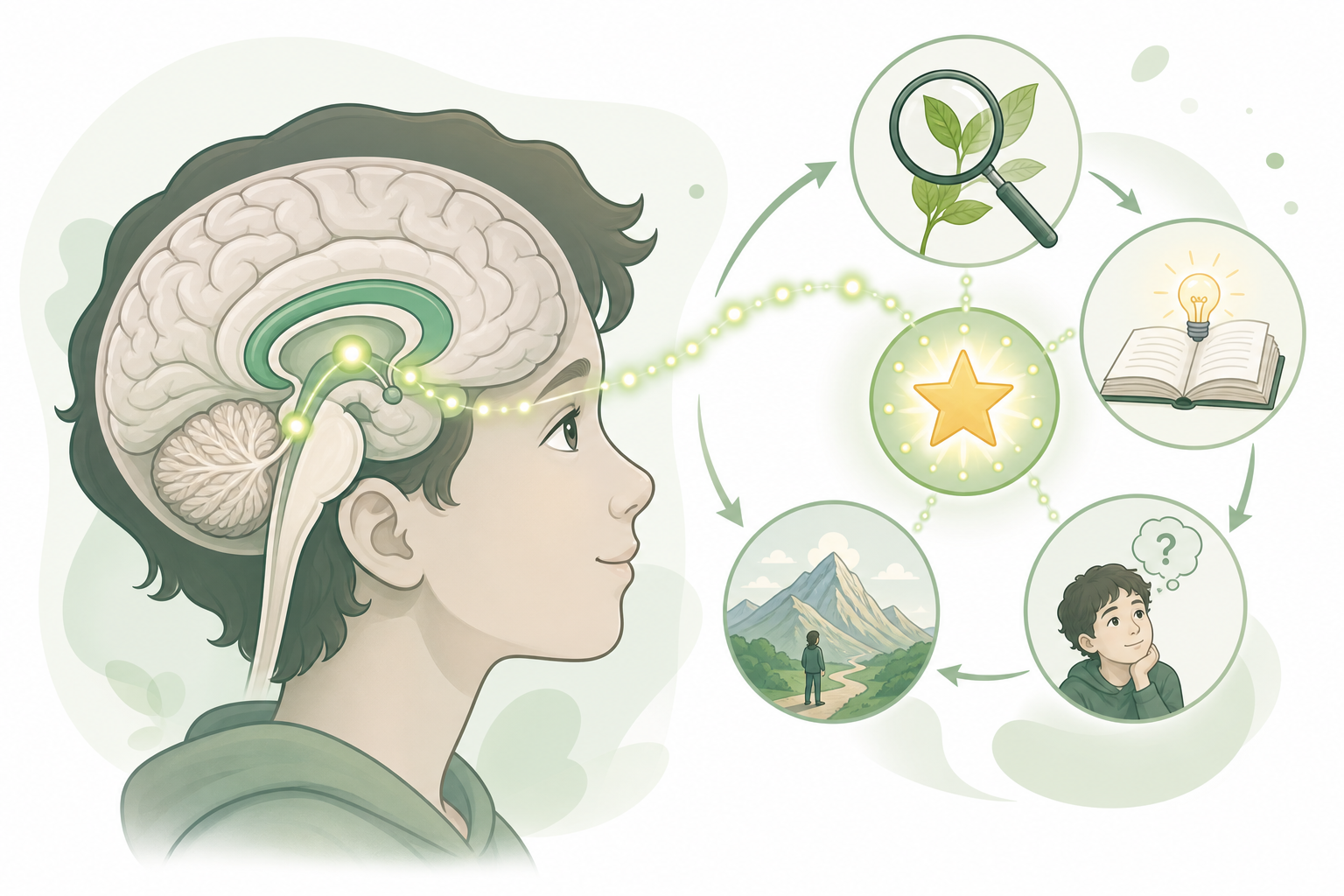
Curiosity is an essential human trait that drives our quest for knowledge and understanding. It stems from a fascinating interplay within our brain, particularly the release of dopamine in the reward system, which makes us feel pleasure when we discover something new. This mechanism supports cognitive development and lifelong learning, benefiting both personal growth and social connections.
In One Sentence
Curiosity is primarily driven by our brain's reward system, especially through dopamine release. This pleasure fosters cognitive growth and encourages continual exploration.

Original AI-generated educational image for Why Science Daily.
The Mechanism in Motion
Curiosity deeply interlinks with neuroscience, involving various brain regions, particularly the prefrontal cortex and the striatum. When faced with uncertainty or new information, the prefrontal cortex engages to evaluate the situation, while the striatum becomes active, signaling the need for exploration. This dynamic interaction often triggers dopamine release, the neurotransmitter associated with pleasure and reward, enhancing the experience of ensuring our understanding of something unknown (NIH).
Research shows that engaging in curiosity not only improves learning experiences but also results in better memory retention. When learners encounter material that intrigues them, their motivation to delve deeper increases, leading to more profound learning (National Institutes of Health). For instance, students actively asking questions like “How does this work?” or “Why does it happen?” often develop self-directed inquiry, which further ignites their intrinsic motivation, making learning a more immersive experience.
Moreover, intrinsic motivation serves as a crucial factor in curiosity-driven exploration. This perspective focuses on internal desires to learn rather than external rewards, like grades or praise. Studies suggest that intrinsic motivation cultivates a more enriching learning experience compared to extrinsic motivators. When individuals follow their curiosity, their learning becomes holistic, fostering a richer understanding of the topic (University of Minnesota).
The benefits of curiosity extend beyond academia. Engaging with new ideas or unfamiliar environments decreases anxiety and enhances overall emotional well-being. Psychological studies indicate that curiosity aids in increasing resilience and adaptability, vital traits in navigating an ever-changing world (PubMed Central). By allowing ourselves to explore and question freely, we pave the way for innovation and creativity, serving as the driving forces for personal and professional development.
Ultimately, curiosity is a significant facilitator in not just cognitive skills but also emotional growth. Researchers indicate that curiosity can enhance social connectivity and enhance our abilities to empathize with others. As we connect with new perspectives or experiences, we foster a greater understanding of diverse cultures and viewpoints, making curiosity invaluable in our increasingly interconnected societies.

Original AI-generated educational image for Why Science Daily.
A Real-World Lens
Consider a young child who builds a volcano model for a school project. Initially, their curiosity might prompt them to question, 'What causes a volcano to erupt?' This pivotal inquiry leads them to explore earth sciences deeper. As they engage with videos and visit local science museums, they expand their understanding, not only discovering why eruptions occur but also catching a broader interest in geology and environmental science. This instance exemplifies how curiosity creates a continuous cycle of inquiry and learning, propelling further exploration and knowledge acquisition.
In professional environments, curiosity can spark innovation. For example, a software engineer faced with a challenge may be tempted to rely on familiar solutions. However, if curiosity drives them to investigate alternative methods or technologies, they might unearth novel solutions that not only resolve the issue but improve overall project efficiency. This not only enhances their problem-solving capabilities but fosters a workplace culture that values continuous learning and collaborative innovation—an essential aspect in today's rapidly evolving job market.

Original AI-generated educational image for Why Science Daily.
Myth Check
Many misunderstandings about curiosity arise from viewing it merely as a benign desire to ask questions. In fact, curiosity is a complex neurocognitive process that entails active engagement, requiring motivation and cognitive skills. Feeling curious does not inherently result in the quest for knowledge; it necessitates a deeper connection to motivation and analysis, otherwise, individuals may simply remain passive seekers of information.
Additionally, there’s a misconception that curiosity is only beneficial within academic or professional settings. On the contrary, the impact of curiosity resonates across life domains, enhancing creativity, promoting social interactions, and nurturing emotional resilience. Engaging our curiosity broadens our experiences, enriching interpersonal relationships and fostering understanding in various contexts, from social circles to family dynamics and community involvement. Thus, curiosity extends beyond just classroom advantages, proving crucial for personal growth and happiness.
The Main Idea to Keep
Curiosity is a powerful catalyst for both cognitive and emotional development. Understanding the underlying mechanisms of our brain's reward system can help nurture curiosity, enhancing our life's quality through enriched learning, social connections, and personal growth.
What Changes the Outcome
| Part | Focus | What to remember |
|---|---|---|
| Main idea | Curiosity | Curiosity deeply interlinks with neuroscience, involving various brain regions, particularly the prefrontal cortex and the striatum. When fa… |
| Common mistake | Misconception | Many misunderstandings about curiosity arise from viewing it merely as a benign desire to ask questions. In fact, curiosity is a complex neu… |
| Everyday takeaway | Practical meaning | Curiosity is a powerful catalyst for both cognitive and emotional development. Understanding the underlying mechanisms of our brain's reward… |
Useful Questions
Why is curiosity important?
Curiosity enhances cognitive abilities and emotional intelligence, essential for lifelong learning and psychological well-being. It encourages exploration and critical thinking.
How does curiosity impact education?
Curiosity motivates students to engage more deeply with material, increasing retention. A curious mind is more likely to pursue self-directed inquiry, enriching the educational experience.
Can curiosity be cultivated?
Yes, curiosity can be nurtured through practice by encouraging questioning, exploring new experiences, and fostering discussions that spark interest.
Are there downsides to curiosity?
While generally advantageous, unchecked curiosity can lead to distractions. Balancing focus with exploration is important to harness its benefits effectively.
How does curiosity relate to mental health?
Curiosity enhances emotional resilience and social connectivity, positively impacting mental health. Engaging with varied interests can help mitigate anxiety and foster well-being.
Is curiosity the same for everyone?
Curiosity levels can vary widely among individuals based on personality traits, experiences, and opportunities for inquiry and exploration. Some may find themselves naturally more inclined to engage with the world.
Source Notes
- Curiosity-driven exploration: foundations in neuroscience and computational modeling
- The role of intrinsic motivations in attention allocation and shifting
- Hunters, busybodies, and the knowledge network building associated with deprivation curiosity
- The Multifaceted Role of Self-Generated Question Asking in Curiosity-Driven Learning
Originality notice: This article is published by Why Science Daily. Please cite and link to the original page when referencing this content.
Keywords: Curiosity, cognitive development, learning, psychology, motivation, neuroscience, exploration, intrinsic motivation