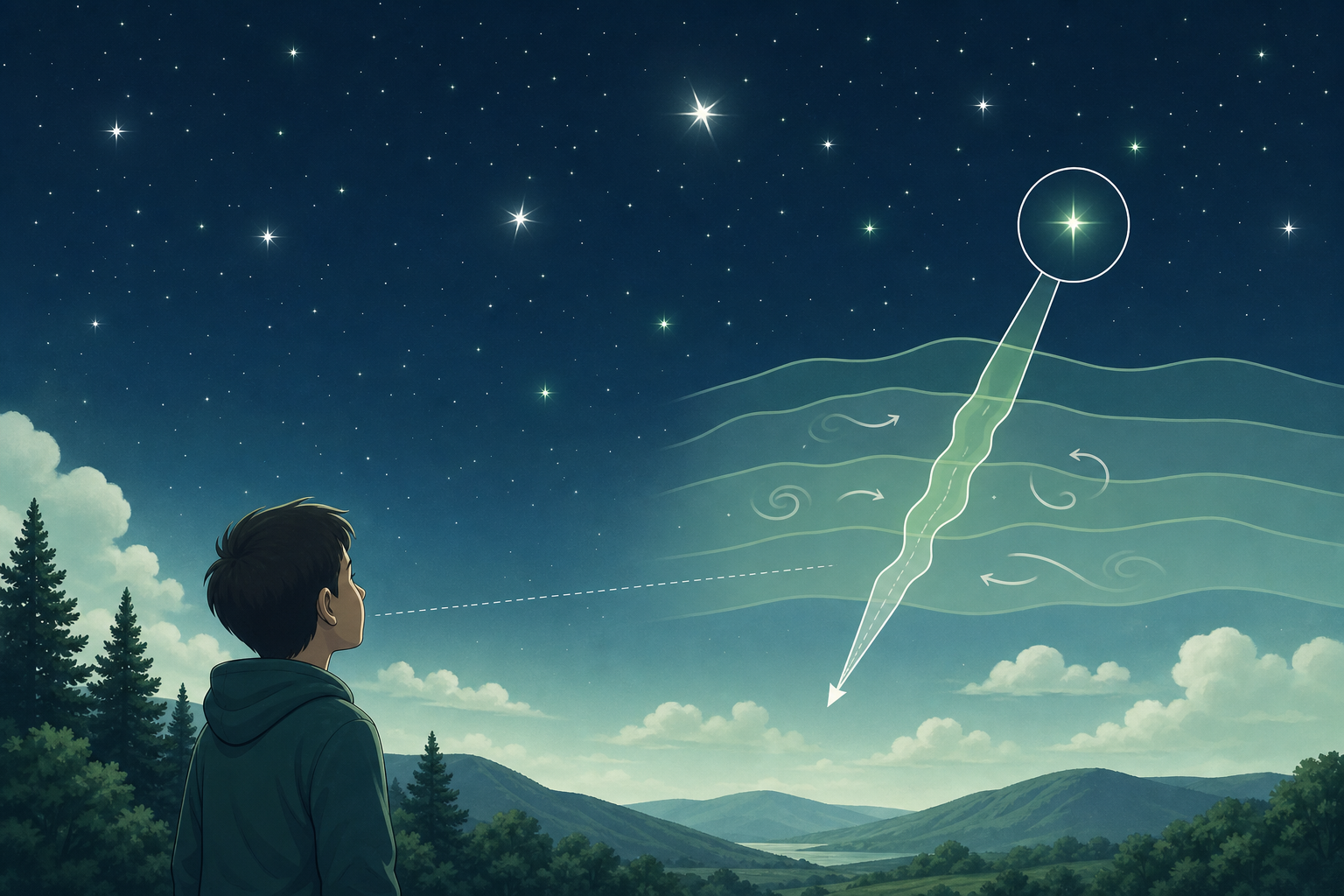
Stars twinkle due to a phenomenon known as light refraction. As light from a star enters Earth's atmosphere, it is bent and disturbed by varying air densities, creating the twinkling effect we see. This atmospheric turbulence causes the light to shift in color and intensity, making stars appear to flicker, especially when they are near the horizon. Understanding this mechanism allows us to appreciate the beauty of the night sky even more.
Start With the Answer
The twinkling of stars is primarily caused by light refraction in Earth’s atmosphere. Variations in temperature and pressure create turbulence, bending the light as it travels. This optical distortion leads to the mesmerizing flicker we observe in stars, particularly when they are lower in the sky.

Original AI-generated educational image for Why Science Daily.
Begin With an Everyday Example
Consider a clear night when you gaze up at the stars. If you notice a bright star, such as Sirius, glimmering intensely, it illustrates light refraction beautifully. The flickering might catch your eye more than fainter stars due to the contrast created by atmospheric distortions. Capturing this phenomenon can often lead to awe and wonder, prompting discussions about the nature of light and perception.
Now think about those nights when the sky is overcast or full of clouds. During such times, twinkling may be less noticeable, as clouds can diffuse starlight and somewhat obscure the direct view. Even as clouds shift, the view of twinkling stars can be affected intermittently, confirming that changes in viewing conditions directly impact our stellar observations. This variability emphasizes the helpfulness of knowing the ideal conditions for stargazing.
For amateur astronomers and stargazers, being aware of these factors can enhance your sky-watching experience. On nights with less atmospheric disturbance, using a telescope can provide clearer, steadier images of stars. Conversely, when atmospheric conditions are not optimal, employing filters may help reduce the effects of twinkling in your observations. Techniques like these are beneficial when planning for special celestial events, such as meteor showers or planetary alignments, where stargazing conditions can vary greatly.
Similarly, if you're trying to photograph stars, consider the effects of atmosphere and weather. Planning your photography sessions during a period of high atmospheric stability can yield the best results. The twinkling and any bounce in color from atmospheric conditions will add a unique character to your dynamic astrophotography, aiding in capturing the splendor of the heavens above.

Original AI-generated educational image for Why Science Daily.
Follow the Science Step by Step
The primary reason stars twinkle is a phenomenon called light refraction. This occurs when light from a star passes through layers of air in the atmosphere, where temperature and pressure vary. Each layer has a different density, causing the light to bend at different angles. As light travels, these changes create a shifting effect, causing the brightness and color of the star's light to fluctuate as it reaches our eyes.
When the atmosphere is calm, stars twinkle less. However, on windy or turbulent nights, the atmosphere's shifting layers lead to more significant refraction and, thus, increased twinkling. This variation is especially pronounced for stars located near the horizon, since the light from these stars travels through a greater volume of atmosphere before reaching our eyes. Viewing conditions, therefore, play a critical role in how much twinkling we observe.
Interestingly, planets, which often appear as bright points of light, typically do not twinkle like stars. This is primarily due to their proximity to Earth. Planets are much closer than stars, allowing them to appear as discs rather than point sources of light. The greater size of a planet's disc averages out the distortions caused by the atmosphere, making them appear steadier. For instance, if you observe a bright planet such as Venus or Jupiter next to a star on a clear night, you will likely notice that the planet shines more steadily, while the star flickers dramatically.
Additionally, light can be influenced by various atmospheric phenomena such as mirages, clouds, and even pollutants. When these factors are in play, they may enhance or diminish the twinkling effect, providing a variable stargazing experience each night. Astronomers take these atmospheric conditions into account when conducting observations, opting for specific techniques or equipment to minimize the impact of atmospheric distortion on their observations.
To further illustrate this, let's consider a scenario where you are observing the night sky from a city. Urban air pollution can scatter and absorb light, further complicating conditions for star gazing. Similarly, high humidity or temperature fluctuations can intensify turbulence, leading to more pronounced twinkling. On nights with clearer skies, twinkling becomes less noticeable as the atmosphere stabilizes, offering a more serene view of stars and their constellations.

Original AI-generated educational image for Why Science Daily.
A Tempting but Incomplete Explanation
A common misconception is that twinkling is solely due to stars being light-years away. While distance does play a role in their apparent brightness, the actual reason for twinkling primarily involves atmospheric conditions. Many may mistakenly believe that all celestial bodies twinkle equally; however, only distant stars exhibit this effect due to their pinpoint size compared to planets.
Another misconception is that the colors of a twinkling star indicate its type or temperature. In reality, the various colors seen are a direct result of atmospheric refraction rather than actual changes in the star's color. As the starlight passes through different layers of the atmosphere, it gets bent in such a way that we perceive it as flashing different colors.
Additionally, many people might think that all stars twinkle with the same intensity or frequency. In truth, factors such as distance, temperature, and atmospheric conditions can lead to varying degrees of twinkling among different stars. For example, the brighter and closer a star is, the less noticeable its twinkling effect may be. Stars like Sirius, which is one of the brightest in the night sky, may twinkle excessively simply because of atmospheric effects, even though they are relatively nearby in cosmic terms. This highlights the complexity of our interactions with light from celestial objects.
The Practical Conclusion
In summary, stars twinkle primarily because of light refraction caused by Earth's atmosphere. Understanding this mechanism not only enhances our appreciation of the night sky, revealing the complex interplay between celestial light and atmospheric conditions, but it also opens up avenues for better stargazing techniques and experiences.
Mechanism at a Glance
| Part | Focus | What to remember |
|---|---|---|
| Main idea | star twinkling | The primary reason stars twinkle is a phenomenon called light refraction. This occurs when light from a star passes through layers of air in… |
| Common mistake | Misconception | A common misconception is that twinkling is solely due to stars being light-years away. While distance does play a role in their apparent br… |
| Everyday takeaway | Practical meaning | In summary, stars twinkle primarily because of light refraction caused by Earth's atmosphere. Understanding this mechanism not only enhances… |
Common Follow-Up Questions
What causes the light from stars to bend?
The bending occurs due to light refraction as it passes through layers of the Earth's atmosphere, which have varying densities. These layers differ in temperature and pressure.
Why do stars appear to change colors while twinkling?
The changing colors are not actual variations in the star's color, but rather optical illusions created by atmospheric refraction. The atmosphere bends light differently, creating a spectrum of colors.
Do planets twinkle like stars?
No, planets do not twinkle as much as stars because they are closer to Earth and appear as discs, averaging out the atmospheric distortions.
Is star twinkling more pronounced in certain conditions?
Yes, twinkling is often more pronounced during turbulent atmospheric conditions and when stars are near the horizon due to the increased thickness of atmosphere the light travels through.
Can weather affect how stars twinkle?
Absolutely! Weather conditions such as clouds and humidity can obscure stars and affect how noticeable their twinkling appears. Clear skies offer the best visibility.
References Used for This Explanation
- Why Do Stars Twinkle? | Stars, Astronomy, & Facts | Britannica
- Why do stars twinkle? | StarChild | NASA
- Why do stars twinkle whereas planets do not? | Physics FAQ | University of California, Riverside
Originality notice: This article is published by Why Science Daily. Please cite and link to the original page when referencing this content.
Keywords: star twinkling, light refraction, atmospheric turbulence, viewing conditions, stars vs. planets, twinkling stars explanation, astronomy for beginners, stargazing tips