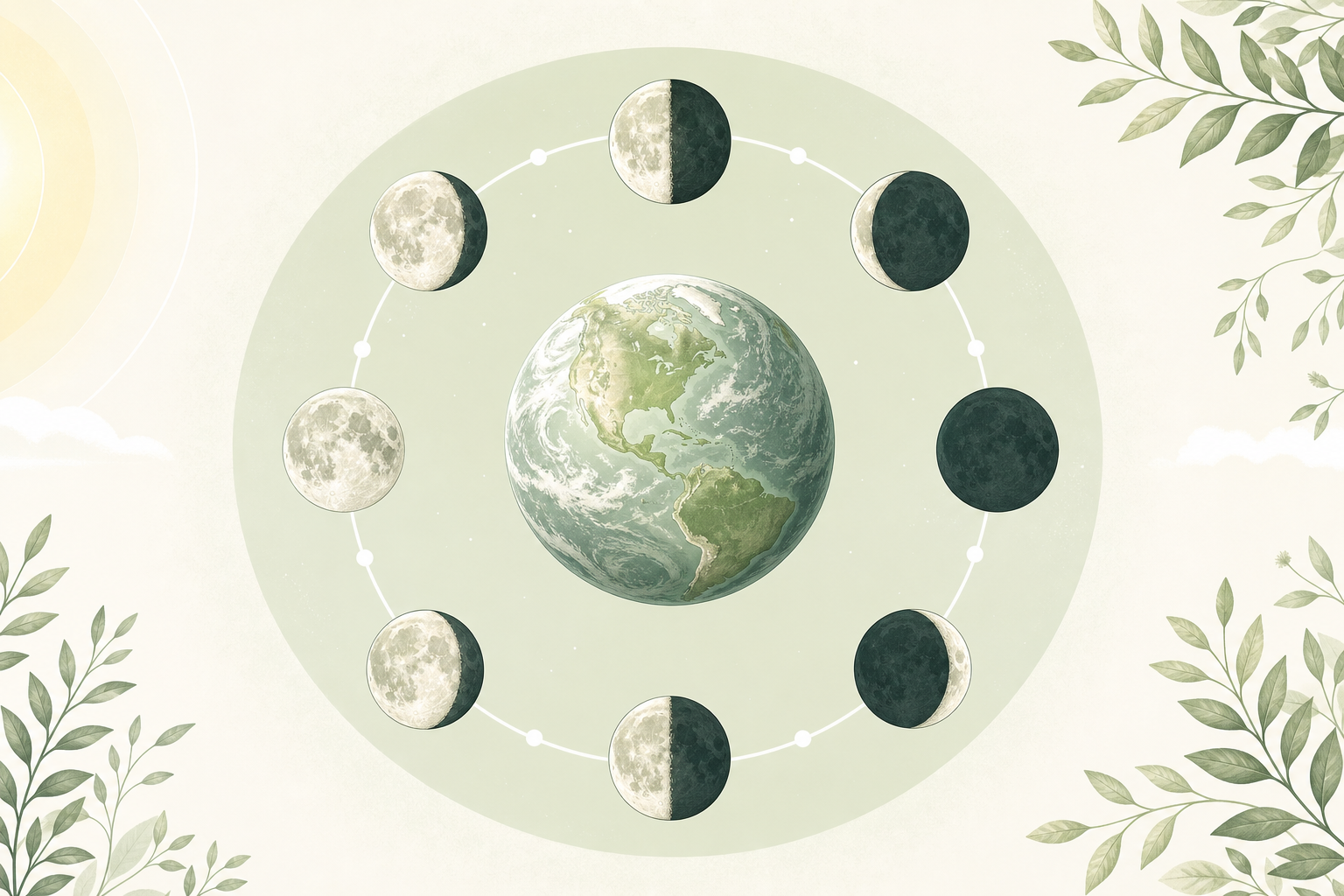
The Moon changes shape due to its phases, which are influenced by the relative positions of the Earth, Moon, and Sun. As the Moon orbits Earth, sunlight illuminates different portions of its surface, resulting in distinct appearances such as new moons, crescents, and full moons. A thorough understanding of this process reveals essential insights about both astronomical mechanics and our everyday experiences.
The Moon's phases, which give it its changing shapes, depend on its orbit around Earth and how sunlight illuminates its surface from various angles. This cycle lasts approximately 29.5 days.
In One Sentence
The Moon's phases, which give it its changing shapes, depend on its orbit around Earth and how sunlight illuminates its surface from various angles. This cycle lasts approximately 29.5 days.

Original AI-generated educational image for Why Science Daily.
The Mechanism in Motion
Each month, the Moon undergoes eight recognized phases, which represent different positions in its orbit around Earth. These are: new moon, waxing crescent, first quarter, waxing gibbous, full moon, waning gibbous, last quarter, and waning crescent. The terms 'waxing' and 'waning' describe whether the illuminated portion of the Moon is increasing or decreasing.
During the new moon phase, the Moon is positioned directly between Earth and the Sun, causing the side facing Earth to be dark. As it continues its orbit, we start to see a sliver of light, marking the onset of the waxing crescent phase. This illumination grows until we reach the first quarter, where half of the Moon is visible as a distinct half-circle.
The full moon occurs when the Moon is directly opposite the Sun, allowing its entire surface to be lit and visible from Earth. After this peak, the Moon begins to wane, with the illuminated portion gradually decreasing until it returns to the new moon phase.
This lunar cycle spans about 29.5 days, known as a lunar month. Interestingly, while the Moon's complete orbit around Earth takes approximately 27.3 days, this extra time accounts for Earth's movement around the Sun. Thus, each lunar cycle lasts slightly longer than the Moon's orbital period.
Understanding moon phases prompts a broader exploration of celestial interactions. Consider observing the Moon on a night when it appears fully illuminated; this phenomenon derives from the specific arrangement of the Sun, Moon, and Earth. Engaging with this practical science clarifies complex concepts. By separating visible results from underlying mechanisms, we achieve a reliable understanding of how celestial bodies interact. Instead of viewing the Moon as a mere natural event, it becomes a key for understanding the spatial dynamics of our universe.
The Moon's position not only affects how we perceive it visually but also influences various tangible scenarios on Earth. The predictable rhythm of the lunar cycle impacts timekeeping, seasonal changes, and cultural practices, revealing intricate connections between celestial mechanics and daily life. Reflecting on these cosmic cycles enhances our appreciation for how these interactions shape our experiences and knowledge of the universe.
A helpful exercise is to connect visible results back to moon phases. Although observing moon phases may seem straightforward, it relies on complex interactions between the Moon, sunlight, and orbital mechanics. This extra layer of detail prevents oversimplification and ensures a comprehensive understanding.
Another insightful angle revolves around scale. The crucial details related to moon phases are often too small or gradual for direct observation. Science clarifies the situation by distinguishing the visible pattern from hidden mechanisms, carefully examining which forces, materials, or motions significantly impact the observable results. Thus, a thorough answer may seem less dramatic but is ultimately more dependable.
Readers can test their understanding by considering the impact of changes in scale or environmental conditions on moon phases. Such thought experiments clarify whether the explanation adequately describes mechanisms instead of merely restating visible phenomena. Contrasting normal situations with near-misses or failures can illuminate the specific parts of the system that truly contribute to these lunar effects.

Original AI-generated educational image for Why Science Daily.
A Real-World Lens
The Moon's phases notably influence several practical aspects of daily life. For instance, farmers have historically relied on lunar cycles to guide their planting and harvesting schedules. Aligning agricultural efforts with the Moon's phases can optimize conditions related to light and soil moisture, potentially maximizing crop yields.
In leisure activities such as fishing, many anglers consult lunar calendars. While some scientific studies provide limited evidence supporting the notion that specific phases enhance fish activity, the tradition persists, showing a blend of ancient wisdom with contemporary fishing practices. Anglers often report increased fish activity during full moons when improved visibility can influence fish behavior.
The Moon's visibility is also pertinent for urban planning and lighting strategies. Architects and city planners often consider natural illumination from the Moon during different phases. For instance, events held during a full moon may require less artificial lighting, reducing costs while creating a more atmospheric experience for participants. These examples illustrate that a deeper comprehension of the Moon's phases not only piques interest but also has practical applications across agriculture, recreation, and environmental management.

Original AI-generated educational image for Why Science Daily.
Myth Check
A common misconception is that the Moon physically changes shape. In truth, the Moon maintains its spherical form during all phases; the apparent transformations are optical illusions resulting from varying sunlight illumination at different angles relative to Earth and the Sun. This misunderstanding often arises among children, who may think the Moon is malleable.
Additionally, people frequently believe that lunar phases exert influence over human behavior. Many folklore narratives link full moons to greater emotional intensity or unusual actions. However, substantial scientific research challenges this belief, demonstrating that moon phases merely reflect visual phenomena based on light and geometry, devoid of any proven psychological or behavioral impact.
There is also confusion regarding the Moon's visibility during its phases. A viewer may expect to observe the Moon at all times in the evening, but its visibility is contingent upon its current phase and position in the sky. For example, a full moon rises at sunset and sets around sunrise, while a new moon is generally invisible from Earth, resulting in varied opportunities for viewing.
The Main Idea to Keep
The Moon's changing shape, dictated by its positioning relative to Earth and the Sun, fascinates and influences various facets of life. Understanding these phases helps us connect with nature's rhythms and enhances our practical actions.
What Changes the Outcome
| Part | Focus | What to remember |
|---|---|---|
| Main idea | moon phases | Each month, the Moon undergoes eight recognized phases, which represent different positions in its orbit around Earth. These are: new moon,… |
| Common mistake | Misconception | A common misconception is that the Moon physically changes shape. In truth, the Moon maintains its spherical form during all phases; the app… |
| Everyday takeaway | Practical meaning | The Moon's changing shape, dictated by its positioning relative to Earth and the Sun, fascinates and influences various facets of life. Unde… |
Useful Questions
How long does it take for the Moon to complete one full phase cycle?
The Moon takes about 29.5 days to complete a full cycle of phases, transitioning from a new moon to a full moon and back.
Why does the Moon appear larger on some nights?
The Moon seems larger near the horizon due to an optical illusion called the 'moon illusion,' which makes it appear bigger against the landscape.
Can the Moon's phases be predicted?
Yes, the Moon's phases can be predicted based on its orbit, making them easy to track using lunar calendars.
Do different cultures perceive the Moon's phases differently?
Indeed, cultures worldwide attribute various meanings and significance to the Moon phases, often connecting them to myths, agricultural events, and rituals.
What impact would the absence of the Moon have on Earth?
Without the Moon, Earth would experience greater climatic variations and tidal fluctuations, as the Moon plays a vital role in stabilizing Earth's axial tilt and tidal patterns.
Source Notes
- Moon Phases – NASA Science
- Earth's Moon – NASA Science
- Earth's Moon – NASA Science
- NASA's Daily Moon Guide
- AstroPages | Moon Phases | Western Washington University
Originality notice: This article is published by Why Science Daily. Please cite and link to the original page when referencing this content.
Keywords: moon phases, moon, sunlight, orbit, phase, celestial mechanics, lunar visibility, new moon, full moon