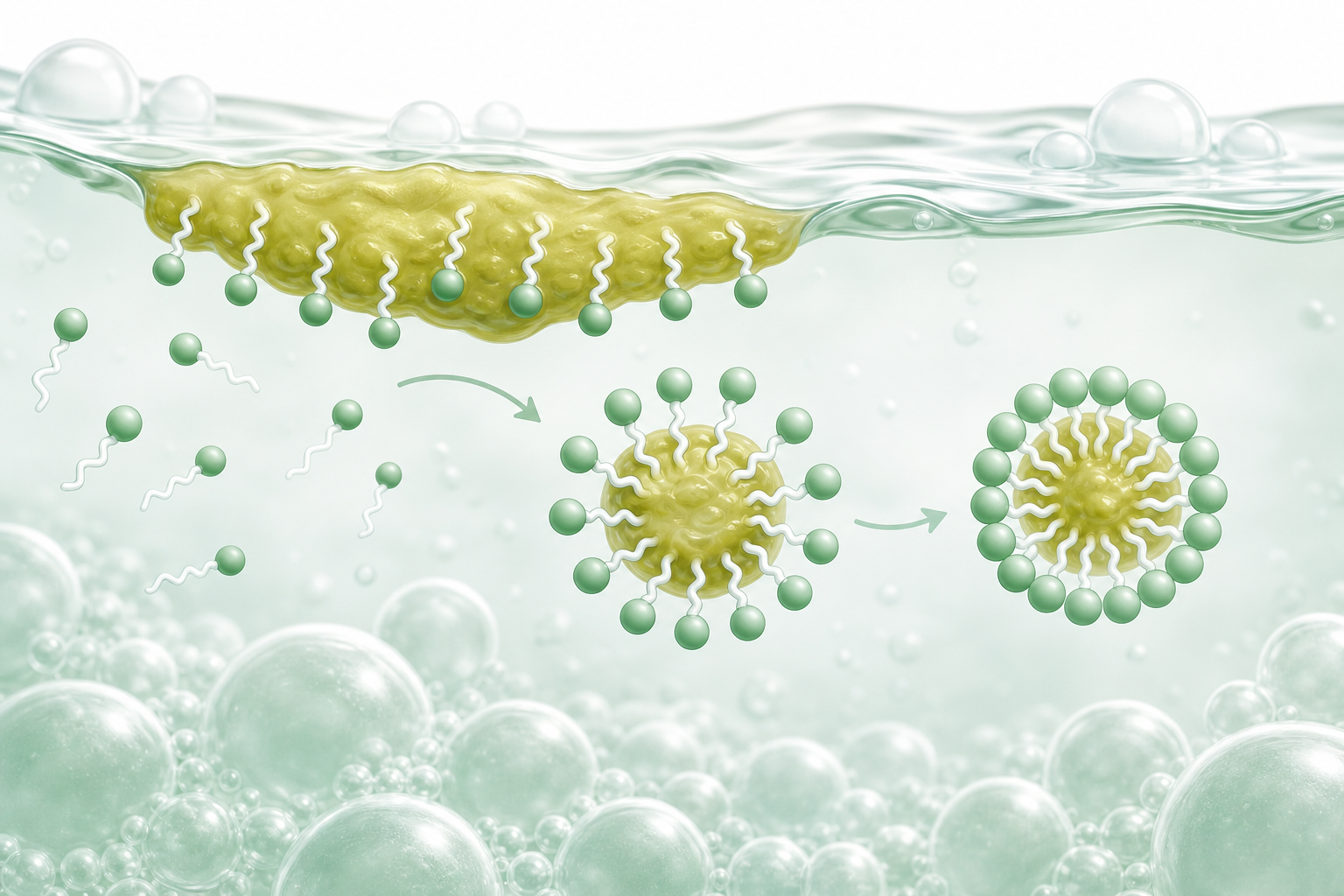
Soap effectively removes grease due to its unique molecular structure, which allows it to form micelles. These micelles encapsulate oil and grease, making them easily rinse away with water. This fascinating mechanism underlies why soap is a staple in everyday cleaning, transforming the task of removing persistent grease into a straightforward activity.
Soap works by forming micelles that trap grease and oil, allowing them to be washed away with water. This ability is due to soap's surfactant properties, which lower the surface tension between water and oil, making cleaning efficient.
The Short Answer
Soap works by forming micelles that trap grease and oil, allowing them to be washed away with water. This ability is due to soap's surfactant properties, which lower the surface tension between water and oil, making cleaning efficient.

Original AI-generated educational image for Why Science Daily.
The Science Behind It
To understand how soap removes grease, we first need to explore the scientific concept of micelles. Soap molecules contain a hydrophilic (water-attracting) head and a hydrophobic (water-repelling) tail. When introduced to water, soap molecules align themselves so that the hydrophilic heads face outwards towards the water while the hydrophobic tails cluster inward away from the water. This arrangement creates structures known as micelles.
Grease and oil are typically non-polar substances, meaning they cannot easily mix with polar substances like water. However, when soap is added to a greasy surface, the hydrophobic tails of soap molecules latch onto the grease. The hydrophilic heads remain in contact with the surrounding water, allowing for effective interaction. In this way, soap acts as a bridge between the water and the grease, facilitating their combination that would not occur if soap were not present.
As the soap molecules surround the grease, they form micelles. A micelle functions like a tiny container, encapsulating the grease within its core. By rinsing with water, these micelles are carried away along with the trapped grease, resulting in a clean surface. This dual-action approach demonstrates not only the effectiveness of soap but also highlights fundamental principles of surface tension and cohesion. Essentially, soap reduces the surface tension of water, allowing it to spread out more easily and penetrate greasy substances.
The effectiveness of soap is also influenced by its concentration. At low concentrations, soap molecules may remain dispersed in water without forming micelles, thus diminishing their cleaning power. Conversely, at higher concentrations, there are sufficient soap molecules to swiftly form micelles, enhancing their ability to lift away dirt and oils. This characteristic makes soap a highly versatile cleaning agent, effective not only in households but also in industrial contexts.
A useful way to conceptualize these interactions is through the lens of observable results. When rinsing a greasy dish, a user might see the visible soap bubbles indicating the interaction between soap and grease. This observation positions soap as a dynamic entity working in concert with the physical properties of water and grease, leading to effective cleaning.
One essential caveat is that not every soap is created equally. Different soaps have varying surfactant compositions, which can significantly impact their effectiveness in different scenarios. While some soaps excel at removing kitchen grease, others might be more suitable for personal hygiene applications. Additionally, factors such as water hardness—how much calcium and magnesium is dissolved in it—can influence soap's performance, underscoring the need for careful selection based on cleaning tasks.
Understanding the nuanced role of soap and micelles encourages a deeper appreciation for the science behind everyday products. It illuminates how interactions at a molecular level result in the effective cleaning tools we often take for granted. As such, appreciating the balance between conditions affecting soap's performance can guide better choices in both household and industrial cleaning applications.
A useful way to check the idea is to connect the visible result back to micelles. In the case of soap, the everyday observation can look simple, but it depends on how oil, water, micelles interact under ordinary conditions. That extra layer matters because it keeps the explanation from turning into a shortcut or a slogan. The point is not that one factor does everything, but that several small physical conditions combine to produce the familiar result.
Another helpful angle is scale. With soap, the details that matter are often too small, too spread out, or too gradual to notice directly. Science explains the scene by separating the visible pattern from the hidden mechanism, then asking which forces, materials, or motions are large enough to matter. That is why a careful answer usually sounds less dramatic than the first guess, but it is also more reliable.

Original AI-generated educational image for Why Science Daily.
The Common Misconception
One common misconception is that soap merely pushes grease away rather than actually lifting it off surfaces. In reality, soap must first interact with the grease at a molecular level to be effective. Without the formation of micelles, grease would remain stubbornly stuck to surfaces, refusing to be removed simply through mechanical action.
Another misunderstanding is that all soaps work in the same way. In fact, the effectiveness of a soap can vary significantly depending on its molecular composition and purity. For example, dish soaps are formulated to tackle kitchen grease, while hand soaps may focus more on skin-safe ingredients. This variation means that not all soaps are equally effective against all types of grime and oil. Additionally, it’s vital to consider environmental factors such as water hardness and temperature, both of which can alter soap performance. For instance, hard water may inhibit soap from developing micelles effectively, diminishing its cleaning efficiency.
Understanding these nuances enables users to make informed choices, selecting the appropriate soap for specific tasks and environments. Enhanced knowledge empowers users to avoid pitfalls and ensure that their cleaning processes are as effective as possible, saving both time and effort in their daily routines.

Original AI-generated educational image for Why Science Daily.
A Real-World Example
To illustrate soap's effectiveness in our daily lives, consider washing greasy dishes. After preparing a meal that involved frying, one often faces the task of cleaning greasy plates and pans. When you apply dish soap to a greasy surface, you’ll notice how easily the oil begins to disperse. This interaction is evident when you rinse the pan with water—grease that seemed bonded to the surface is washed away, showcasing the action of micelles encapsulating and lifting away the grease.
Another example is during handwashing after food preparation. When you wash your hands with soap after touching raw meat or produce, the soap does more than just remove visible oil and dirt; it also captures and eliminates microscopic bacteria and viruses that could lead to illness. This underscores soap's dual role in both cleaning and disinfecting, showcasing its essential qualities that extend beyond simple grease removal.
You can also replicate this soap mechanism at home using a simple science experiment. By mixing oil and water in a clear glass and then adding a few drops of dish soap, you'll observe the fascinating transformation as soap helps the two initially immiscible liquids to blend. This visual demonstration not only illustrates how soap functions at a fundamental level but also offers insight into its practical role in our daily cleaning routines. By understanding how soap works to bridge the gap between water and grease, you gain a deeper appreciation for this common household item, enabling you to leverage its full cleaning potential.
Final Takeaway
In summary, soap's ability to remove grease is due to its unique molecular structure and the formation of micelles. By grasping this mechanism, we enhance our understanding of the science behind everyday cleaning products, allowing for more informed choices and appreciating their effectiveness.
Quick Comparison
| Part | Focus | What to remember |
|---|---|---|
| Main idea | soap | To understand how soap removes grease, we first need to explore the scientific concept of micelles. Soap molecules contain a hydrophilic (wa… |
| Common mistake | Misconception | One common misconception is that soap merely pushes grease away rather than actually lifting it off surfaces. In reality, soap must first in… |
| Everyday takeaway | Practical meaning | In summary, soap's ability to remove grease is due to its unique molecular structure and the formation of micelles. By grasping this mechani… |
FAQ
What are micelles?
Micelles are structures formed by soap molecules in water, where the hydrophilic heads face outward and the hydrophobic tails cluster inward. This arrangement allows them to trap grease and oil.
Why can’t water alone remove grease?
Water cannot remove grease because grease is non-polar and does not mix with polar solvents like water. Soap helps bridge this gap by allowing grease and water to interact.
Does all soap work the same way?
No, different soaps have varying surfactant properties and molecular compositions, affecting their effectiveness against different types of grease and cleaning tasks.
Can temperature affect soap's cleaning power?
Yes, higher temperatures can enhance soap's effectiveness as heat reduces viscosity, promoting quicker micelle formation and better grease removal.
Is soap harmful to the environment?
Many traditional soaps can be harmful to aquatic life. Eco-friendly soaps aim to mitigate this impact by using biodegradable ingredients.
Sources and Further Reading
- American Chemical Society (ACS) – https://www.acs.org
- Chemistry Education – https://www.chemistryeducation.org
- Royal Society of Chemistry – https://www.rsc.org
- National Center for Biotechnology Information – https://www.ncbi.nlm.nih.gov
Originality notice: This article is published by Why Science Daily. Please cite and link to the original page when referencing this content.
Keywords: soap, oil, water, micelles, surfactant, cleaning, grease, homemade cleaners, surface tension