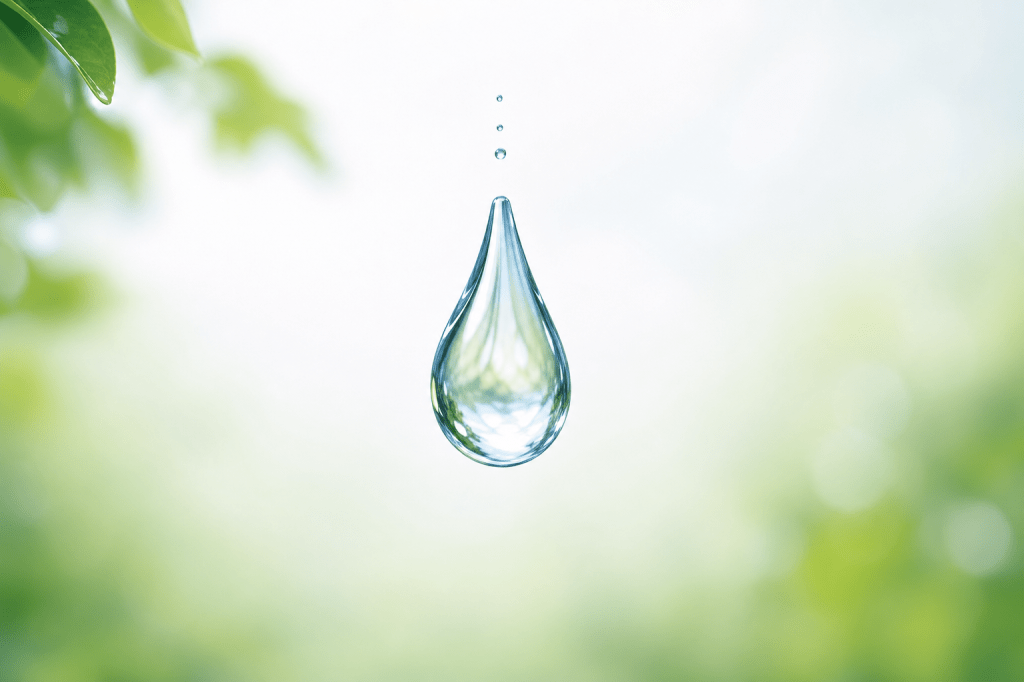
Rain does not usually hurt us because each raindrop is tiny, light, and slowed down by air resistance. Even when a drop begins high in the sky, it quickly reaches a limited falling speed called terminal velocity instead of accelerating forever toward the ground. The result is simple: ordinary liquid rain may feel cold or annoying, but it does not carry enough concentrated impact energy to injure us.
- A raindrop does not keep accelerating all the way from the cloud.
- Air resistance creates a practical speed limit called terminal velocity.
- Raindrops have very little mass, so their momentum is small.
- Liquid water spreads on impact, while solid hail can concentrate force.
The Short Answer: Rain Falls Fast, But Not Like a Bullet
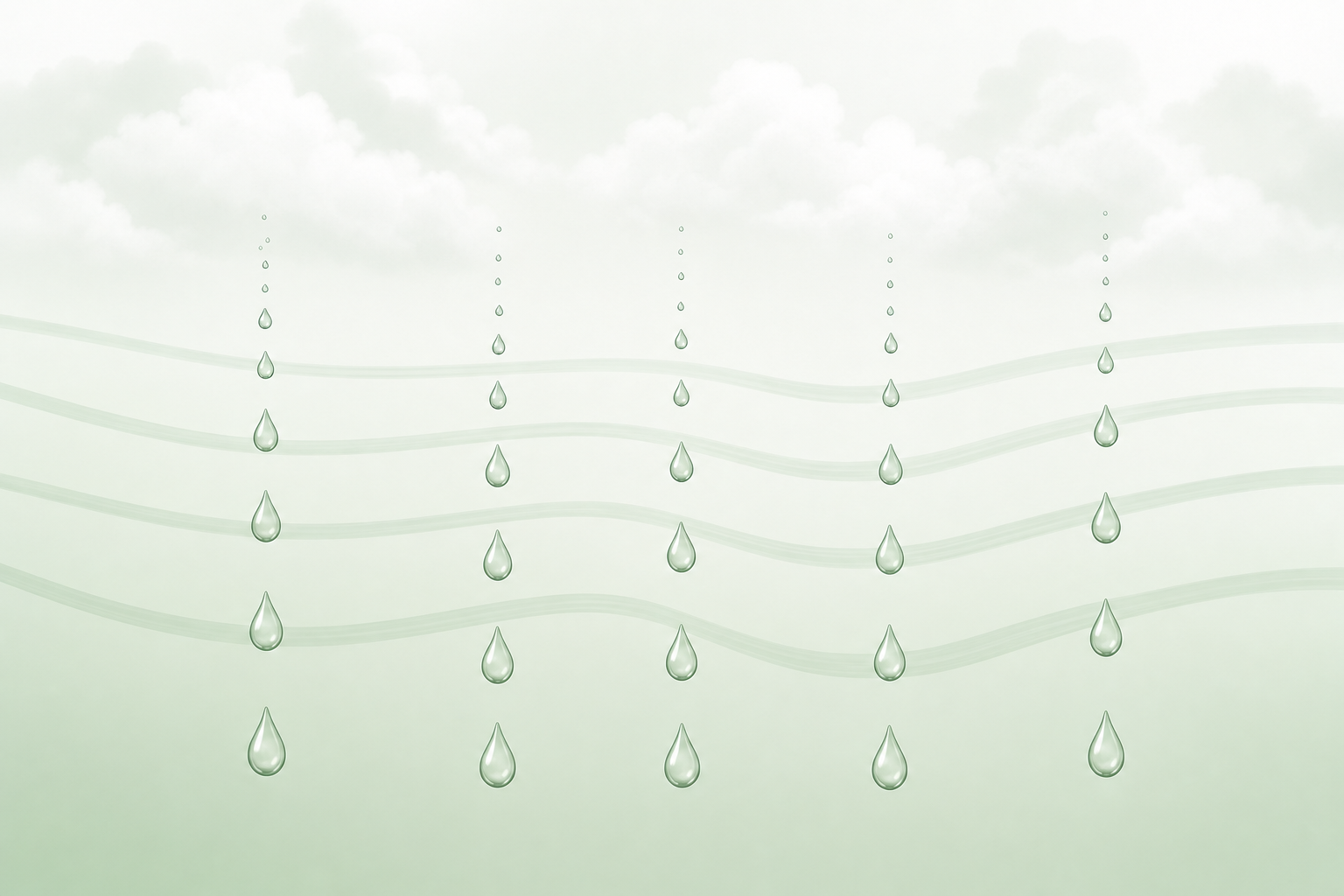
A raindrop may begin thousands of meters above the ground, but it does not become faster and faster without limit. As it falls, the air pushes upward against it. This upward push is called air resistance, or drag. The faster the drop moves, the stronger that drag becomes.
Eventually, the downward pull of gravity and the upward force of drag nearly balance each other. At that point, the drop reaches terminal velocity: the fastest speed it can keep while falling through air. NASA’s Global Precipitation Measurement mission explains that the largest raindrops in still air reach a maximum terminal speed of about 10 meters per second. That is quick enough to feel, but it is nowhere near the speed or energy of a dangerous falling solid object.
The key detail is that danger is not decided by height alone. Impact depends on speed, mass, shape, rigidity, and how the object behaves when it lands. Ordinary rain scores low on the dangerous parts of that list: it is small, light, liquid, and strongly affected by air.

Original AI-generated educational image for Why Science Daily. Add a small Why Science Daily watermark before publication when practical.
Why Raindrops Stop Speeding Up
In a vacuum, an object can keep accelerating as gravity pulls it downward. Earth’s atmosphere is not a vacuum. A falling object has to push air out of the way, and that takes energy. The faster the object moves, the stronger the resistance from the air becomes.
For a raindrop, drag becomes important very quickly because the drop is small and has a relatively large surface area compared with its mass. A large falling rock has much more mass behind its motion. A raindrop, by contrast, is a tiny packet of liquid water. Air can slow it effectively.
This is why a cloud’s height is not the whole story. A drop can fall from high above the ground, but after it reaches terminal velocity, extra distance does not make it endlessly faster. The atmosphere acts like a speed limiter. It does not stop the drop, but it prevents the unlimited runaway acceleration people often imagine.
Why a Tiny Mass Makes a Huge Difference
Impact depends on both speed and mass. A raindrop can move quickly enough for you to notice it, especially during heavy rain, but it contains very little water. That means it carries very little momentum compared with a pebble, a hailstone, or any solid object of similar size.
This is the part our intuition often misses. We picture the drop falling from a cloud and assume that a long fall must automatically make it dangerous. But a small liquid drop moving at a limited speed does not deliver much energy to your skin. It is more like a tiny soft packet of water than a hard projectile.
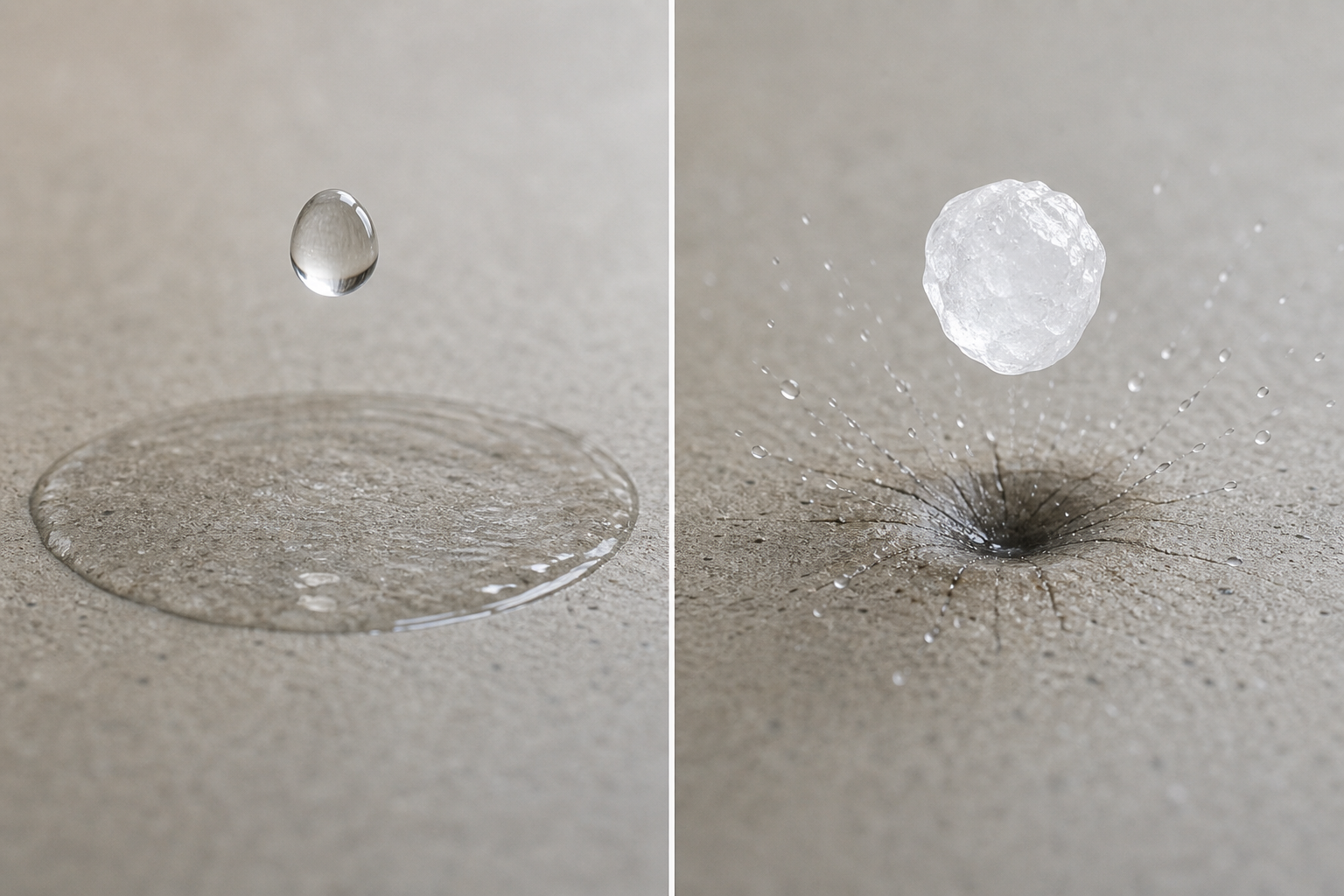
A small raindrop and a small hailstone may both come from clouds, but they do not hit in the same way. Rain is liquid and spreads out. Hail is solid ice and can focus its impact into a smaller area.
What Happens When a Raindrop Hits Your Skin?
A raindrop is liquid, so it does not stay rigid when it lands. It flattens, spreads, and breaks apart. That spreading motion distributes the impact over a slightly wider area and over a short moment of time. The sensation may be sharp during a storm, but the physics is still very different from being struck by a hard object.
A solid object behaves differently. It keeps its shape and concentrates the impact into a smaller contact area. This is one reason a small piece of ice can feel much sharper than liquid rain. The same general idea explains why a snowball, a hailstone, and a splash of water can feel so different even when all three involve water in some form.
Original AI-generated educational image for Why Science Daily. Avoid injury visuals, fake labels, logos, or copied stock imagery.
Then Why Can Hail Be Dangerous?
Hail is different because it is ice. It can be larger, denser, and much more rigid than a raindrop. When hail falls during a severe thunderstorm, it can damage cars, roofs, crops, and sometimes injure people.
The National Weather Service warns that severe thunderstorms can produce large hail along with dangerous lightning, wind, and flash flooding. So the safe conclusion is not “falling things from clouds are harmless.” The correct conclusion is more specific: ordinary liquid raindrops are usually safe because their speed, mass, and shape limit the impact.
Rain vs. Hail: The Important Difference
| Feature | Ordinary rain | Hail |
|---|---|---|
| State | Liquid water | Solid ice |
| Impact behavior | Spreads and breaks apart | Stays rigid and concentrates force |
| Typical risk | Low for normal rain | Can be dangerous, especially when large |
| Main science principle | Terminal velocity and low mass | Greater mass, rigidity, and storm conditions |
Original AI-generated educational image for Why Science Daily. Generate without embedded text; add any labels in WordPress or CapCut.
The Common Misconception
The common misunderstanding is that falling distance alone decides danger. It feels reasonable: if something falls from high enough, it should become deadly. That idea would be closer to true in a vacuum or for a heavy object with low drag. It is not the right model for ordinary rain.
Rain falls through air, and air is not empty. For a small droplet, drag is strong enough to set a speed limit. The drop is also liquid and light. Those three details change the answer completely. This is why everyday science is useful: it shows where our intuition is close, where it is incomplete, and what hidden factor actually matters.
What This Teaches Us About Falling Objects
The rain question is a small example of a bigger physics idea. Whenever something falls, we should ask more than “How high did it fall from?” We should also ask how much mass it has, how much air resistance it experiences, what shape it has, whether it is solid or liquid, and how it transfers force when it lands.
A feather, a raindrop, a hailstone, and a skydiver all fall under gravity, but they do not fall in the same way. Their terminal velocities are different because their mass, shape, and surface area are different. That is why the same planet, the same gravity, and the same atmosphere can produce very different falling speeds.
For ordinary rain, the answer is reassuring. The atmosphere slows the drops, the water has little mass, and the liquid spreads on contact. That combination is why a storm can soak your clothes without turning every raindrop into a dangerous projectile.
FAQ
How fast do raindrops fall?
Raindrop speed depends on drop size and surrounding air conditions. NASA GPM explains that the largest drops in still air reach about 10 meters per second, while smaller drops fall more slowly. Wind, turbulence, and drop breakup can make real rain more complicated than a single number.
Why does heavy rain sometimes sting?
Heavy rain can sting because many drops are hitting your skin quickly, and some drops may be larger than usual. The feeling can be uncomfortable, especially in wind-driven rain, but ordinary rain still has far less impact energy than solid hail or falling debris.
Would rain be dangerous without air?
Without air resistance, falling drops would not be limited in the same way. But ordinary rain as we know it exists in an atmosphere, so drag is part of the real-world physics. Removing the air changes the problem into a different thought experiment.
Why does hail hurt more than rain?
Hail is solid ice, so it can be heavier and does not spread out like liquid water. When it hits, more of the impact is concentrated in one place. Large hail can also fall during severe storms, where strong updrafts help hailstones grow before they fall.
Is terminal velocity the same for every object?
No. Terminal velocity depends on mass, shape, size, surface area, and the air around the object. A feather, a raindrop, a hailstone, and a skydiver all have different terminal velocities because they interact with the air in different ways.
Final Takeaway
Rain does not hurt because the atmosphere acts like a speed limiter, and each drop is a tiny liquid object with very little mass. The cloud may be high, but the raindrop does not get an unlimited runway. The simple phrase to remember is this: rain falls far, but it does not fall freely forever.
Sources and Further Reading
- NASA Global Precipitation Measurement Mission: How fast do raindrops fall? https://gpm.nasa.gov/resources/faq/how-fast-do-raindrops-fall
- NASA Global Precipitation Measurement Mission: The Anatomy of a Raindrop. https://gpm.nasa.gov/science/anatomy-of-a-raindrop
- National Weather Service: Severe Thunderstorm Safety. https://www.weather.gov/safety/thunderstorm
Originality notice: This article is published by Why Science Daily. Please cite and link to the original page when referencing this content.
Keywords: rain, raindrops, terminal velocity, air resistance, hail, everyday science, weather science
 Why Science Daily